

Indonesia’s food security faces strong pressure as the environment changes fast. Floods, shifting rainfall, and land-use discussions all show how fragile food production can be. Therefore, Indonesia needs better tools to protect food security. This is why smart agriculture becomes essential. It offers a precise, adaptive, and sustainable way to manage crops, and as a result, it helps secure long-term productivity.
Current Challenges to Food Security in Indonesia
Indonesia still deals with multiple agricultural challenges. As a result, these issues weaken productivity and put food security at risk.
Stagnant Productivity
Many farmers still rely on estimates, not data. As a result, irrigation, fertilizer, and harvest decisions are often not optimal.
Unpredictable Weather
Rain patterns shift often. Because of this, planting calendars keep changing and affecting crop stability.
Declining Agricultural Workforce
Urbanization reduces the number of young farmers. As a result, farming feels outdated and too manual, which weakens regeneration.
Inefficient Supply Chains
Without real-time field data, distribution becomes uneven. As a result, price gaps appear across regions, ultimately weakening food security.
Overall, these issues require faster, data-driven decisions. Therefore, manual methods alone are no longer enough.
What Smart Agriculture Means for Food Security
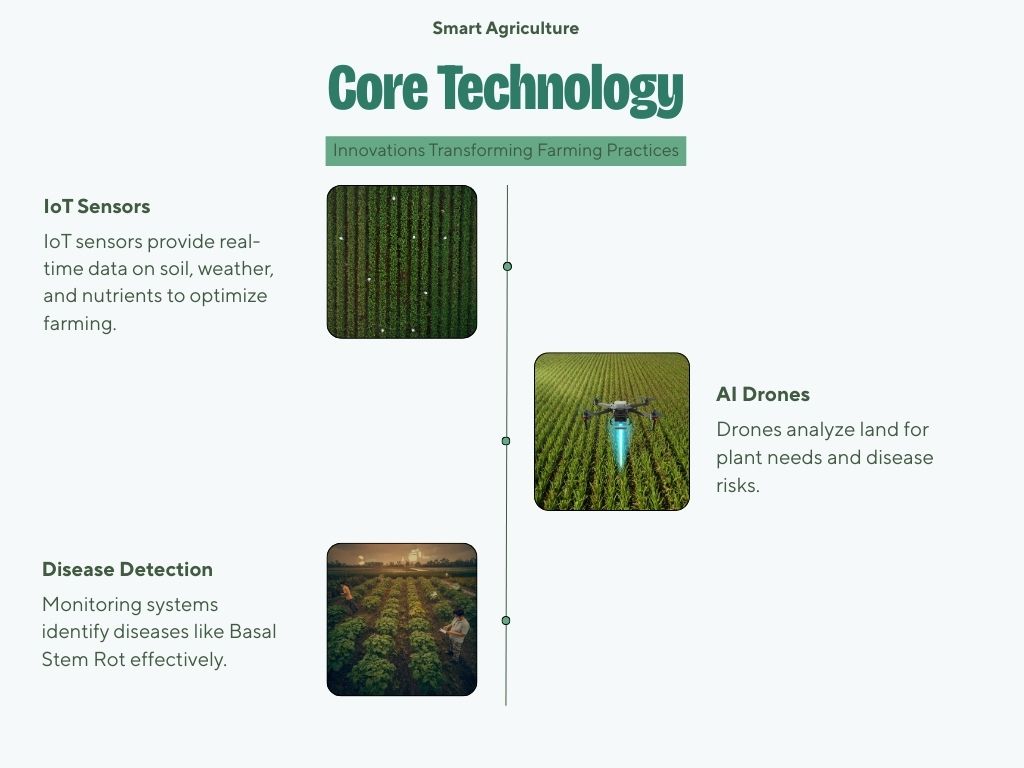
Smart agriculture uses digital technology to improve efficiency, productivity, and sustainability in farming. In addition, it plays a major role in strengthening food security.
Key technologies include:
- IoT sensors for soil, weather, and nutrient monitoring
- AI Drones for field analysis and crop needs and disease risks
- Disease detection systems like Basal Stem Rot monitoring
All systems connect to cloud platforms for real-time insights.
Why Smart Agriculture Supports Food Security
Indonesia still deals with many agricultural challenges. These issues weaken productivity and therefore put food security at risk.
Higher Land Productivity
Real-time sensor and AI data help farmers know the right time to water, fertilize, and harvest. This increases yield without expanding farmland critical as farmland continues to shrink.
Lower Crop Loss from Disease
Early detection systems reduce major losses, including billions in palm oil plantations affected by Basal Stem Rot. Farmers can act before diseases spread.
Reduced Operational Costs
Smart agriculture lowers water use, fertilizer waste, pesticides, and manual labor. Therefore, farm operations become more profitable and efficient.
Better Climate Adaptation
Climate change affects rainfall and temperature. With real-time environmental data, farmers can adjust planting schedules and maintain stable production even during extreme weather.
Stronger National Food Security
More stable yields and data-driven distribution reduce dependency on imports and strengthen Indonesia’s food security.
The Role of Cloud Infrastructure in Smart Agriculture
Smart agriculture depends on strong digital infrastructure. Cloud providers support:
- Large-scale data storage
- Fast edge computing for field processing
- Integrated IoT platforms
- AI analytics for actionable insights
With these tools, farms from smallholders to large corporations become more modern, measurable, and efficient.
Conclusion
Indonesia needs a food system that is strong and stable. Therefore, smart agriculture becomes a key solution. It gives better data, clearer decisions, and more stable harvests. Moreover, it reduces crop loss, improves efficiency, and supports long-term sustainability.
At Indonesian Cloud we help drive this change. We provide secure cloud systems, fast data tools, and reliable AI and IoT platforms. With this digital base, smart agriculture becomes easier to adopt and easier to scale. In turn, farmers, companies, and the nation gain real benefits.
So, if you want to strengthen Indonesia’s food security, contact Indonesian Cloud today. Start building a simple, smart, and data-driven farming ecosystem that lasts.