Protect Your Customers' Personal Data, Strengthen Their Trust, and Elevate Your Business Quality!
What is Personal Data Protection?
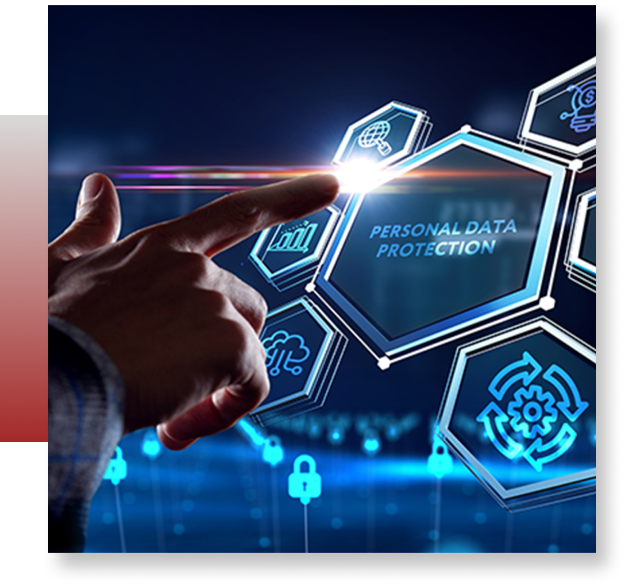
Indonesia’s Personal Data Protection Law (Undang-Undang Perlindungan Data Pribadi / UU PDP) governs how personal data is collected, used, and protected to safeguard individual privacy. The regulation requires any entity that processes personal data to obtain clear and explicit consent from the data owner, maintain data security and confidentiality, and report any data breach incidents in a timely manner.
Non-compliance can result in administrative and criminal penalties, which is why adhering to this law is crucial not only for business security, but also for preserving public trust and organizational credibility.
POJK Nomor 22
Tahun 2023
UU PDP Nomor 27
Tahun 2022
POJK Nomor 11/
POJK.03/2022
Indonesia Personal Data Protection Law
“Act of the Personal Data Protection”
The regulations above have been enacted and officially issued by:
Why Must We Follow Personal Data Protection Regulations?
Individual Penalties
Criminal Penalty – Up to 6 Years
Financial Fine – Up to IDR 6 Billion
Corporate/Company Penalties
Financial Fine – Up to 10× the Individual Penalty
Business License Suspension – 5 Years
Permanent License Revocation and Business Closure
Your Digital Security Starts Here, Explore Our Protection Solutions!
Don’t let personal information become an easy target.
Discover our data protection solutions and start safeguarding your privacy today.
Data collection must be supported by a lawful basis, such as user consent, contractual necessity, or legal obligations.
Consent
Consent must be given freely, be specific, informed, and unambiguous. Individuals must also be able to withdraw their consent at any time.
Data Security
Data controllers must implement appropriate technical and organizational measures to ensure data security.
Purpose Limitation
Personal data must be collected for specified, explicit, and legitimate purposes. It should not be further processed in ways that are incompatible with those original purposes.
Data Subject Rights
Outline the rights of data subjects, including the right to access, correct, delete, and restrict processing.
Data Protection Officer
Organizations that handle large volumes of personal or sensitive data must appoint a Data Protection Officer (DPO) to oversee compliance with Indonesia’s Personal Data Protection Law.
Data Breach Notification
Data controllers must notify the Personal Data Protection Committee Office (PDPC) within 72 hours after becoming aware of a data breach.
Data Transfer
Cross-border data transfers are only allowed to countries with adequate data protection measures, or under specific conditions approved by the data protection authority.
Record Keeping
Data controllers are required to maintain records of their data processing activities and make them available to the data protection authority upon request.
Training & Awareness
Emphasize the importance of training employees on data protection and security practices.
SECURE YOUR DATA
WITH OUR SOLUTIONS
Phase 1
Understand Data Classification
Data classification is a foundational step in the data protection lifecycle. It is the process of consistently organizing and labeling data based on specific, predefined criteria.
Understand Data Classification
Defining Critical Data
Data Classification
Data Discovery
Training Awareness
Legal Data Collection
Purpose Limitation
Data Project Officer
Understand Data Classification
Titus Classification Suite
Forcepoint Data Classification
Phase 2
Monitoring Sensitive Data & Device Encryption
Combining insights from systems, users, and data gives you the visibility needed to defend against evolving threats.
Monitoring Sensitive Data & Device Encryption
Data Monitoring – In Use & In Motion
Data Encryption
Data Breach Notification
Data Transfer
Monitoring Sensitive Data & Device Encryption
Intrusion Detection and Prevention Systems
Security Information and Event Management
Full Disk Encryption
Network Traffic Analysis
Phase 3
Data Protection
Protect data wherever it lives, control connected external devices, govern data flow to those endpoints, and detect unusual user or system behavior.
Data Protection
Data Loss Prevention
Device Control
Intregations with Web, Email, Endpoint
Data Security
Record Keepig
Cloud Applications Control
Data Protection
Endpoint DLP
Network DLP
Email Encryption
Cloud Backup
Disaster Recovery
Phase 4
Rights Management
A software-based method that securely overwrites data on any storage device by applying binary-level rewriting across all device sectors.
Rights Management
Digital Rights Management
Managing Data Leaving the Organisation
Data Erasure
Consent
Data Subject Right
Rights Management
Content Access Control
File Encryption & Usage Restrictions
Secure Data Wiping Tools
Secure your business with confidence! Get a free consultation today!

 Individual Penalties