What Is

Private Cloud

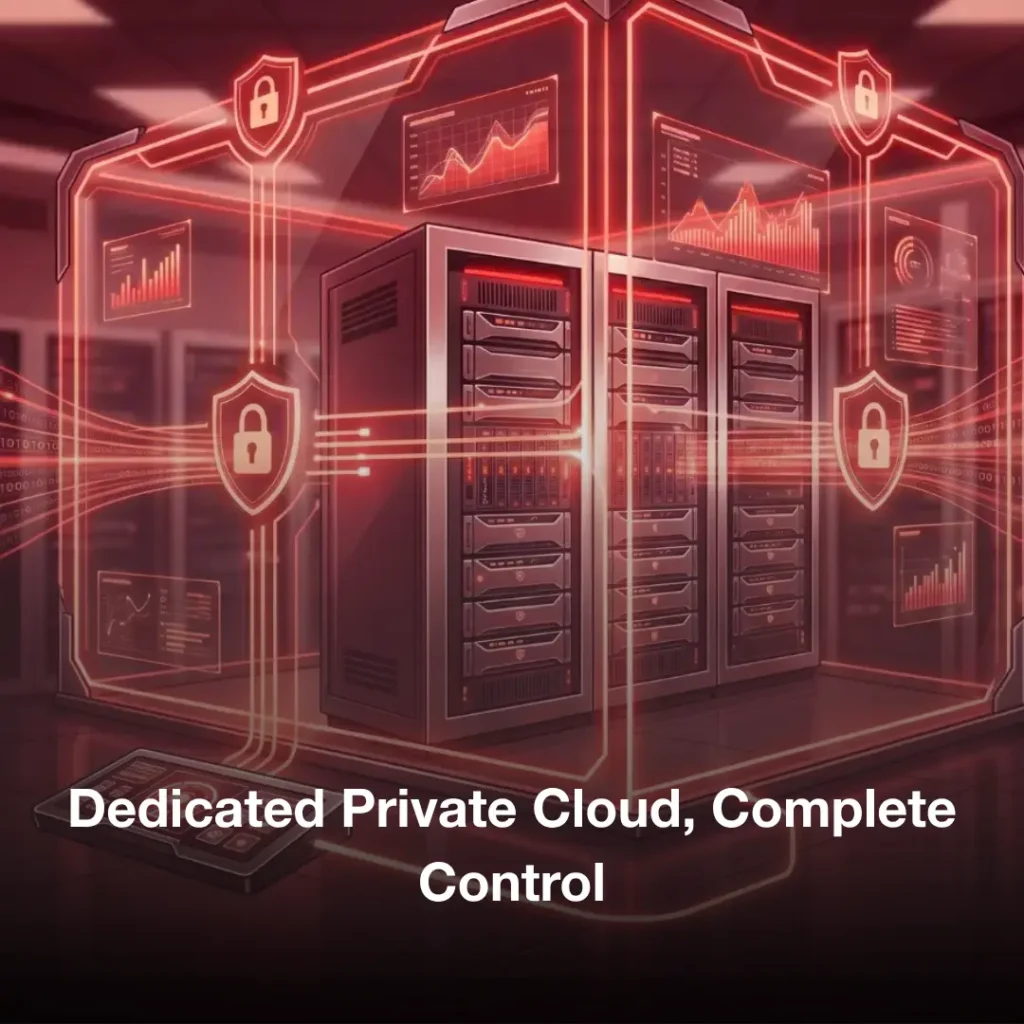
A private cloud is a cloud computing service solution dedicated to a single customer. Private clouds combine many of the benefits of cloud computing with the security and control of local IT infrastructure.

Through a proprietary architecture, Private Cloud is built and managed by Indonesian Cloud, where computing, storage, and network resources are dedicated to the needs and objectives of a single organization. This Private Cloud can be located in the customer’s data center or in the provider’s data center (colocation).

Why Choose We

01

Flexible Deployment

Run websites, applications, databases, and enterprise workloads on a highly adaptable cloud environment

02

Enhanced Security & Performance

Leverage dedicated resources and reliable infrastructure for consistent performance and data protection.

03

Effortless Scalability

Scale computing resources up or down based on your business demands without disrupting operations.

Feature

Interesting Features of Private Cloud by Indonesian Cloud

Security and Compliance

Private clouds provide a high level of security and privacy for data through firewalls and internal hosting.

Full Control

Private clouds have greater control over their resources and hardware than public clouds because they are only accessed by one company.

Improved performance

The use of private cloud dedicated hardware and internal/direct networks offers better performance with increased spee.

No Vendor/Provider Locked-in

Private cloud supports customers who need to adopt multi-cloud, multi-stack strategies to avoid lock-in and ensure they have the agility to optimize the right mix across public cloud.

Flexible VM sizing

In the public cloud, customers are limited by the VM per instance recommendations provided by the vendor. The private cloud gives customers the ability to customize VM configurations (per vCPU, RAM, Storage)

No Data Traffic Cost

Reduce costly data transfer fees and access your data freely with a private cloud solution designed for data-intensive workloads.

Benefit

Uses of Private Cloud by Indonesian Cloud

Dedicated Cloud Infrastructure

For this particular benefit, private cloud usage has its own infrastructure that is not integrated with other cloud infrastructures.

Supported Various Cloud Technology

Our Private Cloud is supported by trusted and reliable cloud technology platforms in their respective fields, namely VMware, Nutanix, Virtuozzo, and Redhat Openstack.

Reliable Security

A reliable level of security to protect your personal data so that it is always secure and safe.

Scalable Capacity

Capacity can be scaled according to your business needs so that you don’t incur excessive expenses.

Monitoring Service

There is a monitoring service so that users can monitor the data stored on our private cloud service.

High Performance

Experience reliable and consistent performance to support your critical business applications and workloads.

You ask, we answer

Have questions? We’ve got answers. Explore our frequently asked questions to learn more about our solutions, features, and services.

Private cloud is a cloud computing infrastructure used exclusively by a single organization or company. Unlike public cloud, all resources such as servers, storage, and networking are not shared with any other party. Private cloud can be managed independently at the company’s own data center (on-premise) or through a third party that provides a dedicated isolated environment.

The fundamental difference lies in resource ownership and isolation. In public cloud, infrastructure is shared among many users (multi-tenant), whereas private cloud is single-tenant — used exclusively by one entity. This makes private cloud superior in terms of control, data privacy, and customization capabilities, but at a significantly higher cost.

Private cloud is ideal for organizations with high security and regulatory compliance requirements, such as banking institutions, hospitals, government agencies, or large enterprises managing sensitive data. Additionally, companies with stable and predictable workloads tend to be more cost-efficient with private cloud compared to public cloud.

On the advantages side, private cloud offers full control over data and infrastructure, a higher level of security, extensive customization capabilities, and more consistent performance since resources are not competing with other users. However, the drawbacks include high upfront investment costs for hardware and licensing, the need for a competent in-house IT team for management, and more limited scalability compared to public cloud.

Some commonly used technologies include VMware vSphere for virtualization, OpenStack as an open-source cloud management platform, Microsoft Azure Stack for bringing the Azure ecosystem to an on-premise environment, and Nutanix which offers hyper-converged infrastructure (HCI) solutions. For containerization, many companies also integrate Kubernetes running on top of their private cloud.

Request An Order