
A Learning Management System (LMS) helps companies manage employee training in a more efficient way. Today, organizations want employees who are skilled and motivated. Therefore, many companies invest in training programs.
Employee training improves knowledge and develops new skills. In addition, it helps workers perform better in their roles. In the past, companies often conducted training through traditional classroom sessions.
However, digital technology has changed how training works. As a result, many organizations now deliver training programs online using a Learning Management System.
With an LMS platform, employees can access training materials anytime and from anywhere. Because of this, learning becomes easier for both companies and employees.
What is a Learning Management System?
A Learning Management System (LMS) is a digital platform used to manage learning and training programs inside an organization.
Companies use LMS platforms to provide courses, materials, and training modules to employees. For example, companies can upload videos, documents, and quizzes.
In addition, most LMS platforms include testing and scoring systems. These tools help companies measure employee progress and evaluate learning results.
Therefore, the main goal of a Learning Management System is to improve employee knowledge and skills.
Why Use a Learning Management System?
Traditional training methods can be expensive and difficult to manage. Companies must prepare venues, instructors, and schedules.
However, a Learning Management System simplifies this process.
Training can be delivered online without requiring physical meetings. As a result, companies can save time and operational costs.
Managers can also monitor employee progress through reports and analytics. Because of this, organizations can evaluate training effectiveness more easily.
Features of a Learning Management System
An LMS platform usually provides features for both administrators and employees.
Learning Management System Features for Administrators
Dashboard
The dashboard helps administrators monitor employee learning progress. In addition, the interface is usually user-friendly and easy to understand.
Learning Report
Training reports show detailed information about employee performance. For example, companies can export training data into Excel files for further analysis.
Company Management
This feature allows administrators to manage employee data within the LMS system. Furthermore, companies can organize users based on departments or job levels.
Class Management
Companies can distribute learning materials such as videos, documents, and quizzes. Meanwhile, administrators can create online exams and assignments.
Learning Management System Features for Employees
Pre-Test and Post-Test
Employees can complete tests before and after training sessions. As a result, companies can measure knowledge improvement.
Journey-Based Learning
This feature provides a structured learning path. For example, the process may include pre-tests, training materials, post-tests, and certification.
Mobile, Web, and Desktop Access
Employees can access LMS platforms through multiple devices. Because of this, learning becomes more flexible.
Discussion Forum
Discussion forums allow employees to communicate with each other. In addition, this interaction encourages collaboration and knowledge sharing.
Benefits of Using a Learning Management System
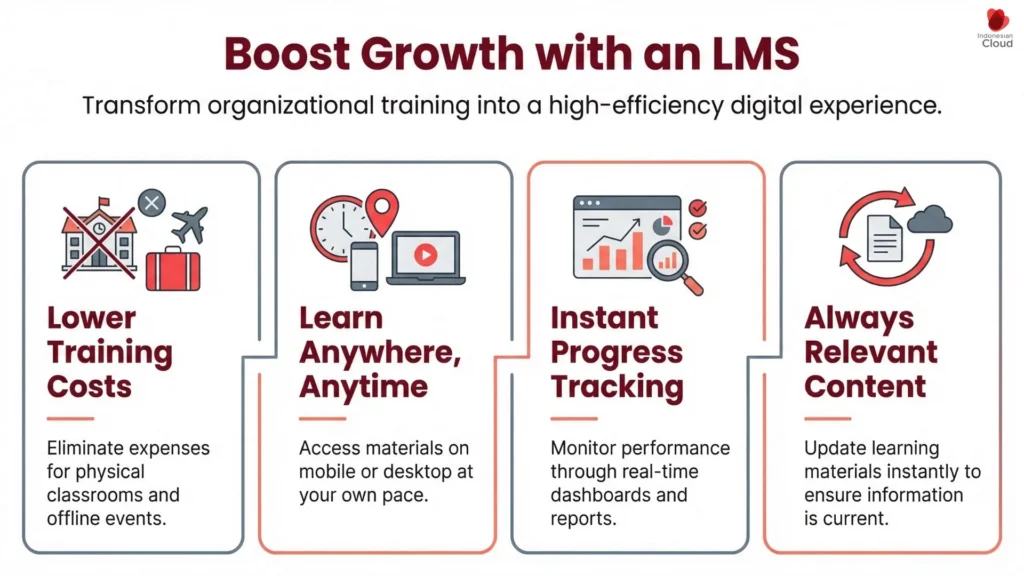
Implementing a Learning Management System provides several advantages.
Lower Training Costs
Companies no longer need physical training venues. As a result, operational costs become lower.
Online Learning Distribution
HR teams can distribute learning materials digitally. In addition, managers can monitor progress through dashboards and reports.
Flexible Learning Time
Employees can access training materials anytime. Therefore, learning becomes more convenient and efficient.
Easier Progress Monitoring
Administrators can track employee performance through LMS analytics. Because of this, companies can evaluate training programs more accurately.
Updated Learning Materials
Companies can update training materials whenever necessary. As a result, employees always receive the most relevant information.
Better Employee Collaboration
Discussion forums encourage communication between employees. Therefore, teamwork and knowledge sharing can improve.
Conclusion
A Learning Management System helps companies manage employee training more effectively.
Digital learning platforms allow employees to study anytime and anywhere. In addition, companies can monitor progress and manage training materials easily.
Therefore, many organizations adopt LMS solutions to improve employee development and productivity.
If you would like to learn more about digital solutions and cloud technology, you can visit our official website at Indonesiancloud.com.
You can also explore reliable VPS services for your business at cloudhostingaja.com.
See you in our next article.