
Many companies treat the decision as simple. Either they rely on an in-house IT team, or they use IT managed services. In practice, the better question is different. It is: which parts must stay in-house, and which parts can be handled with a clear scope and SLA.
Technology today is not only about building systems. It is also about reliability, security, and scale. Complexity keeps rising. Therefore, a blended model often works best.
The Role of In-House IT: Direction and Business Context
In-house IT has a key advantage. It understands the business context deeply. It knows the workflows, the biggest risks, and the most critical systems.
What in-house IT should focus on
In many cases, in-house IT creates the most value when it focuses on:
- Architecture and technology standards
- Governance, security, and compliance
- Long-term roadmap decisions
However, when in-house IT must run daily operations 24/7, strategy can slip. Then direction turns into constant execution.
The Role of IT Managed Services: Daily Operations at Scale
IT managed services do not replace in-house IT. Instead, they absorb operational complexity that is hard to manage internally.
This is even more true in cloud and hybrid environments. Operations often require:
- Always-on availability
- Fast incident response
- Consistent security updates
- Ongoing performance and cost optimization
As a result, teams need specific skills and mature processes. Also, they need a ready-to-respond setup. For many firms, building all of this in-house is not efficient.
IT Managed Services vs In-House IT: Different Focus
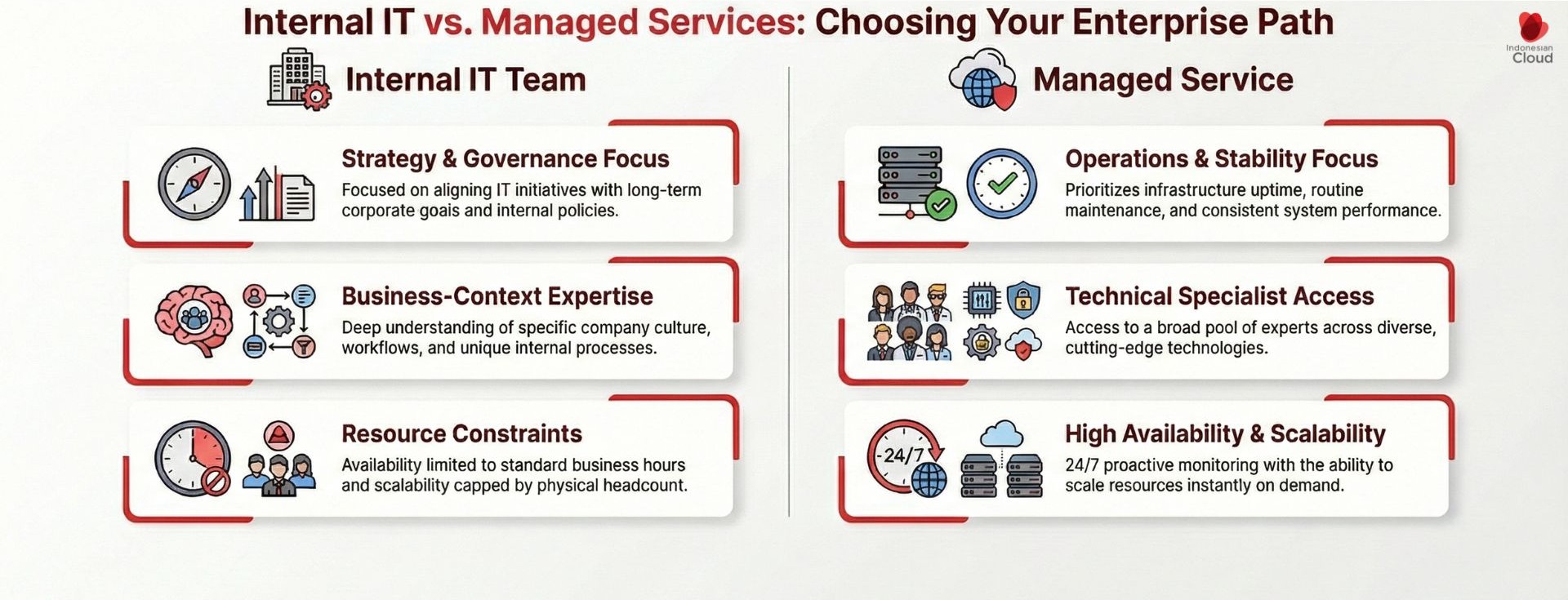
This is not about which one is “better.” It is about which one fits each function.
In-house IT often leads on strategy and business alignment. Meanwhile, IT managed services often lead on daily stability and 24/7 operations.
The Role of IT Managed Services: Daily Operations at Scale
IT managed services do not replace in-house IT. Instead, they absorb operational complexity that is hard to manage internally.
This is even more true in cloud and hybrid environments. Operations often require:
- Always-on availability
- Fast incident response
- Consistent security updates
- Ongoing performance and cost optimization
As a result, teams need specific skills and mature processes. Also, they need a ready-to-respond setup. For many firms, building all of this in-house is not efficient.
IT Managed Services vs In-House IT: Different Focus
This is not about which one is “better.” It is about which one fits each function.
In-house IT often leads on strategy and business alignment. Meanwhile, IT managed services often lead on daily stability and 24/7 operations.
A Practical Model: Split Roles Clearly
A common modern approach is simple. In-house IT stays focused on strategic decisions and business integration. Then IT managed services handle daily operations, reliability, and technical best practices.
Therefore, the organization can move faster without losing control. In-house IT stays as the driver. The managed team becomes a measurable operator.
Business Impact
So, by using IT managed services is not a weakness. Instead, it can reflect a mature IT strategy.
With the right split, companies can:
- Reduce operational risk
- Keep IT services consistent
- Let in-house IT support business growth
In this context, PT Indonesian Cloud supports a balanced operating model. It combines in-house IT strengths with IT managed services built for modern enterprise complexity.