
In-house software development can feel like full control. Teams can tailor features to the business. They can also manage data more directly. However, the real question today is different. It is not only “can we build it.” It is “should we build everything in-house.”
This article explains the trade-offs in a practical way. So you can decide faster and with less risk.
Why Companies Still Choose In-House Software Development
There are clear reasons why in-house still looks attractive:
1) Full control over roadmap and integration
Internal teams often know the workflows well. Therefore, the solution can fit the business tightly.
2) IP ownership
When you build it, the software becomes a company asset. Also, licensing dependency can be lower.
3) Security and compliance perception
In regulated industries, direct control of architecture and data can feel safer than third-party tools.
Still, many benefits look strongest at the planning stage. Later, delivery and operations bring new costs.
he Real Challenges of In-House Software Development
1) Complexity keeps growing
Enterprise software rarely stops at version one. As the business grows, the system must handle more users, more integrations, and stronger security. It also needs 24/7 reliability. As a result, teams need skills across architecture, security, and operations. That talent is not always available in one internal team.
2) Hidden long-term costs
In-house can look cheaper because you “avoid vendor fees.” However, real costs include hiring, retention, trial-and-error time, infrastructure, maintenance, technical debt, and rework risk.
3) Business focus can drift
Every hour spent maintaining support systems is an hour not spent on core differentiation. For most non-tech enterprises, software is an enabler, not the main product.
Build vs Buy: A Practical Middle Path
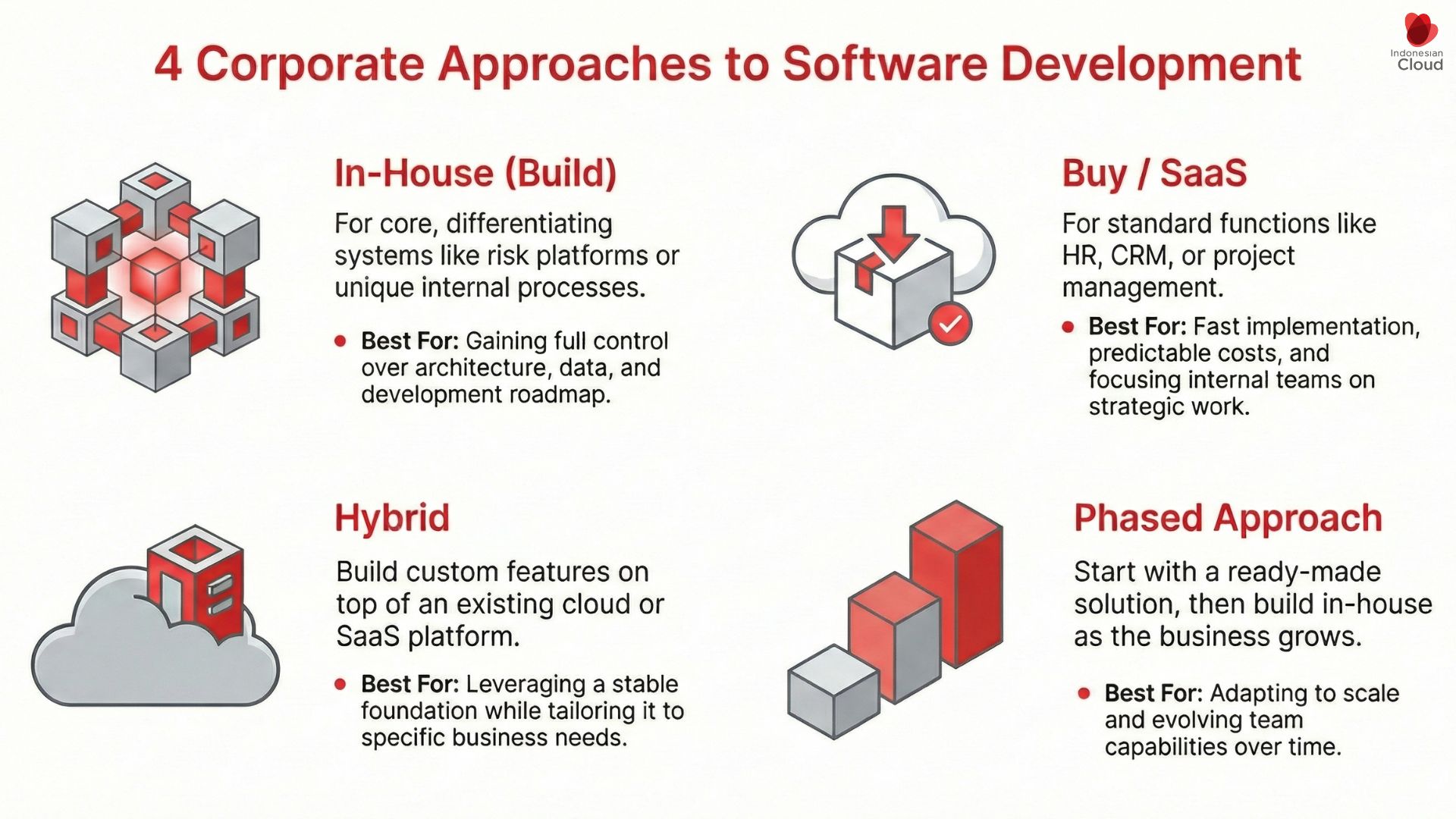
Modern decisions are rarely extreme. Many companies choose a mix: buy standard tools, build what is truly unique, then integrate everything on flexible infrastructure.
Use cases
- Buy/SaaS for standard functions like HR, payroll, CRM, and project management. It is faster. Costs are also more predictable.
- Build (in-house) for core systems that truly differentiate the business.
- Hybrid to add custom features on top of stable cloud or SaaS platforms.
- Phased approach to start with ready solutions, then build in-house as the team matures.
How AI and Cloud Change the Decision
Cloud lets teams build without running every technical layer alone. Meanwhile, AI can support planning, monitoring, and analysis. So you do not need to build everything from scratch. Because of that, build vs buy depends more on your infrastructure readiness and ecosystem choices.
Conclusion
In-house software development is not a wrong choice. However, it is not the answer for every company. So the best decision starts with clarity: what must be unique, what can be standardized, and what should be built in a hybrid way.
If you are weighing build vs buy, Indonesian Cloud can help you assess requirements, design the right architecture, and prepare the infrastructure covering in-house app development, system integration, and an enterprise-ready cloud foundation. As a result, you can move faster while staying secure and scalable.