

Modern organizations invest heavily in data platforms. They use real-time dashboards, automated reports, and advanced analytics. However, data maturity does not always lead to decision maturity. This is where decision readiness becomes critical.
Decision readiness is the ability of an organization to turn insight into timely, confident, and accountable decisions. Without decision readiness, even high-quality data stays passive. As a result, insight becomes discussion material, not a trigger for action.
In practice, many companies already have good insights. The real issue is not data quality. Instead, the organization is not ready to decide.
What Is Decision Readiness?
Decision readiness refers to organizational readiness to convert data insight into real decisions at the right time. It connects analytics with authority, timing, and risk ownership.
In other words, decision readiness ensures that insight answers a clear decision need. It also ensures that someone owns the decision and accepts the risk.
Organizations that master decision readiness move faster. They act with confidence. They do not wait for perfect data.
Is Your Organization Decision-Ready?
Many organizations believe they are data-driven. Yet, their decisions still move slowly. Below are four common signals that decision readiness is missing.
1. Lack of Decision Intent
Insight should serve a decision. However, many dashboards are built without a clear decision goal. Teams explore data first and search for meaning later.
As a result, insights become too broad or arrive too early. They lack business context.
Decision-ready organizations start with one question:
“What decision must be made?”
Only then do they use data to clarify options and consequences.
2. Unclear Decision Ownership
Insight-to-action often fails because ownership is unclear. Everyone joins the discussion. Yet no one holds final authority.
This creates a gray zone. Insight is reviewed but postponed.
Decision readiness requires clarity:
- Decision owner
- Input contributors
- Risk owner
Without this structure, insight will always stall.
3. Undefined Action Window
Every insight has a limited shelf life. If action comes too late, impact drops to zero.
Still, many organizations fail to define decision deadlines. They never ask when a decision stops being useful.
With decision readiness, timing becomes part of quality. Insight is treated as urgent when needed, not just informative.
4. Unclear Risk Posture
Requests for more data often hide a deeper issue. Teams disagree on acceptable risk.
In this case, data becomes a shield. It delays decisions and avoids accountability.
Decision-ready organizations align risk upfront. They define which risks are acceptable. After that, data is used to choose—not to avoid choosing.
How to Build Decision Readiness With Dashboards
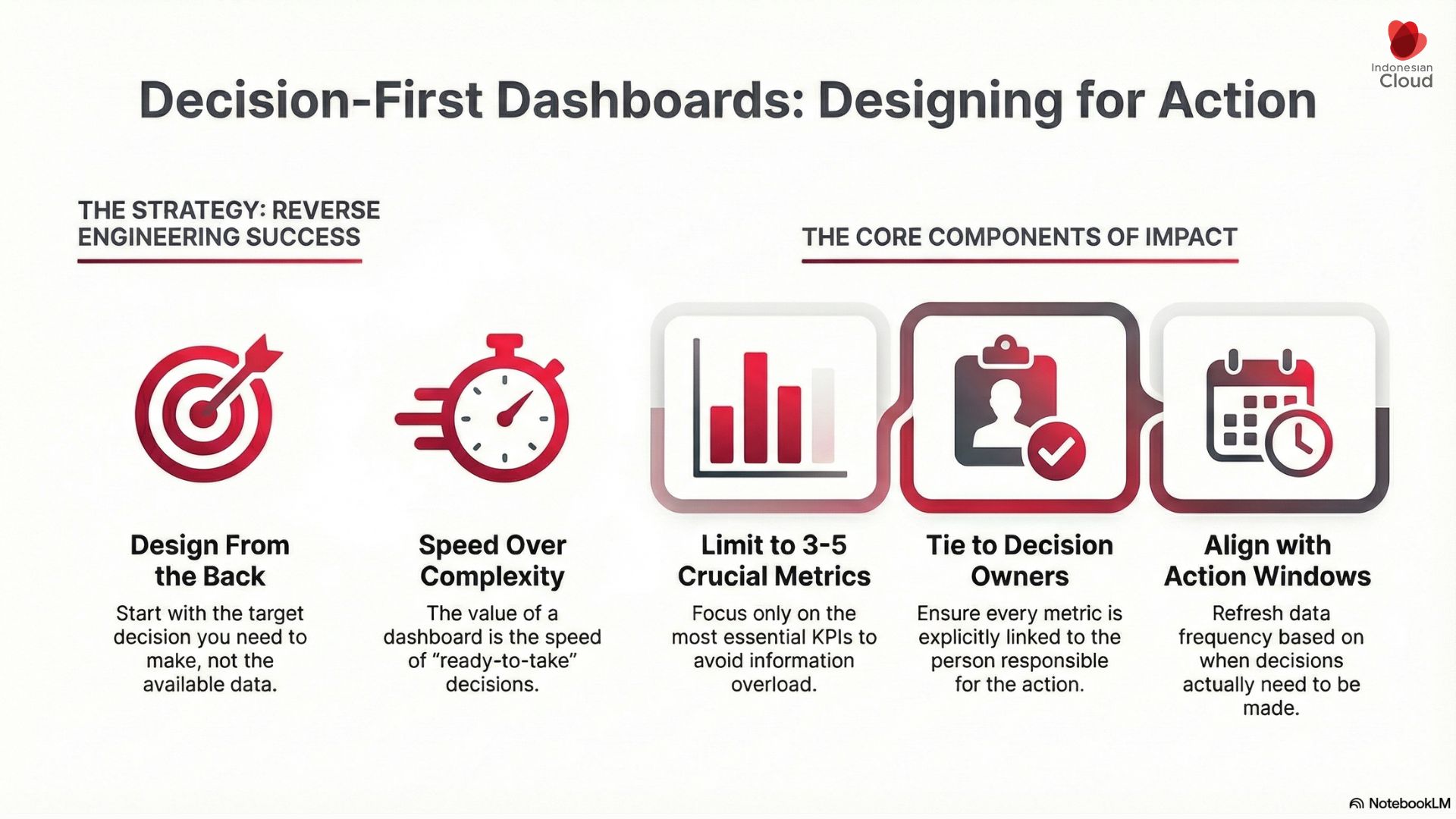
Dashboards should drive decisions, not decorate meetings. To achieve this, they must be designed for decision readiness, not visual completeness.
Below are four practical principles.
Intent-Led Dashboard Design
Start from the decision, not from available data.
Ask: “Which decision must be accelerated this week?”
Then select only 3–5 metrics that directly support that decision. Too many KPIs slow action.
Example: Instead of showing all sales metrics, focus on: “Should the Q1 campaign continue?”
Use only:
- Real-time ROI
- Customer acquisition cost
Clear Ownership and Action Prompts
Every dashboard page should show a Decision Owner. Include name and role.
Next, add action prompts. For example: “If metric X drops below 80%, approve extra budget?”
Automate alerts. Send notifications to the owner with a clear response deadline.
This turns insight into immediate accountability.
Timing-Sensitive Insight
Each insight needs an action window.
For example:
- Inventory dashboard updates every 4 hours
- Alert shows: “Action required within 2 hours”
Use simple signals:
- Green: monitor
- Yellow: review
- Red: decide now
This helps teams act before insight expires.
Embedded Risk Context
Dashboards should show trade-offs, not just numbers.
Add simple risk indicators. For example:
- Option A: 70% success, high cost
- Option B: 50% success, low cost
This forces risk discussion early. Not after decisions stall.
Over time, teams align faster because risk posture is shared.
From Insight to Commitment
Insight creates clarity. Decisions require courage.
Organizations that win are not defined by how much data they collect, but by how decisively they act on the data they already have.
Instead of waiting for perfect insight, they focus on whether they are ready to make a decision.
Conclusion
Most organizations do not suffer from a lack of data or insight. They face a gap between information and commitment.
Without decision readiness clear intent, ownership, timing, and risk alignment dashboards remain reporting tools, not decision engines.
The real challenge is not technology. It is readiness.
Indonesian Cloud helps organizations move beyond insight. Data and analytics are integrated into governance, process, and real decision needs. As a result, insight leads to action, not delay.