
AI in the workplace is rarely introduced to replace people. Most organizations adopt AI to work faster, reduce errors, and manage limited resources. However, as AI becomes part of daily work, human roles begin to shift in subtle but meaningful ways.
The AI impact on human roles in the workplace is not driven by an intention to replace people. Instead, most organizations adopt AI to work faster, cleaner, and with less strain. In practice, AI enters daily work as a support tool, a decision aid, or a response to limited time and resources.
However, once AI becomes routine, its impact goes beyond efficiency. Gradually, human roles begin to shift. This change is rarely planned. It happens because old ways of working no longer fit new realities. As a result, work evolves quietly, without formal labels or strategy sessions, yet the shift is real and ongoing.
AI in the Workplace Is More Than Tasks
Many discussions about AI in the workplace assume that jobs are a list of tasks. When systems can automate some of those tasks, concerns arise about job loss.
In reality, high-value work involves elements that are hard to break into steps, such as:
- understanding context behind data
- judging uncertain situations
- balancing different interests and perspectives
- taking responsibility for outcomes
Therefore, as AI handles routine activities, human focus moves from execution to interpretation and judgment. This shift defines modern human roles in the AI era.
How AI in the Workplace Shifts Focus Without Removing Roles
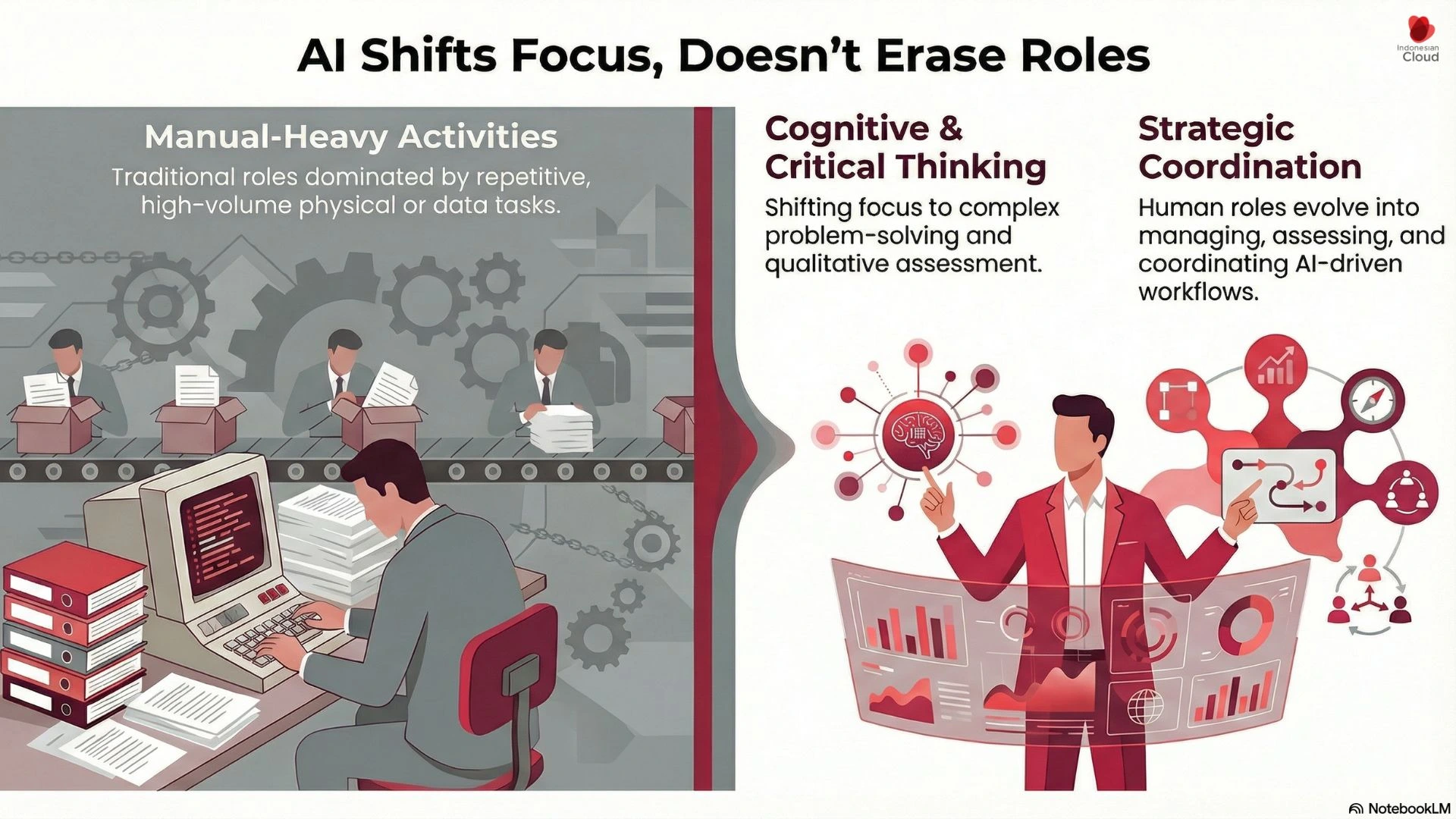
In many organizations, AI helps generate reports, summaries, and recommendations. At first glance, this seems like less work for humans. Yet in practice, the focus of work changes.
Common shifts include:
- collecting data to interpreting meaning
- running processes to ensuring output quality
- asking what happened to deciding what to do next
Human roles do not disappear. Instead, they move toward coordination, evaluation, and accountability. Unfortunately, job structures and role definitions often lag behind this reality.
AI in the Workplace and the Growing Complexity of Decisions
With AI, information becomes faster and options increase. Paradoxically, decision making often becomes more complex.
System-generated recommendations still require interpretation. Their impact must be weighed. Moreover, real-world conditions are not always visible in data. Because of this, humans play a critical role not in calculation, but in judgment.
Even when AI appears objective, responsibility remains with people. This tension is rarely discussed openly, yet it shapes everyday work.
Change Without Design in AI in the Workplace
One major challenge of AI in the workplace is that change often happens without intention. Organizations introduce systems to help, but overlook how roles and responsibilities shift.
This creates gray areas, such as:
- when to trust AI recommendations
- who is accountable when outcomes fail
- how far humans should rely on systems
Without clarity, AI can create confusion and unhealthy dependence rather than support.
AI as a Mirror of Work Culture
Interestingly, AI rarely transforms organizations on its own. Instead, it reinforces existing habits.
Organizations that value discussion use AI as input. More hierarchical organizations use it to justify decisions.
In this way, AI is not neutral. It reflects how an organization views work, trust, and responsibility.
As a result, the AI impact on human roles in the workplace differs widely, even among organizations using similar technologies.
New Challenges for Workers and Leaders
These changes create different challenges.
For workers
- thinking critically about AI output
- maintaining confidence in decision making
- understanding the impact of their choices
For leaders
- ensuring AI improves work quality
- keeping human roles and accountability clear
- preventing critical decisions from hiding behind systems
At this stage, work design and leadership matter as much as technology.
Conclusion
The future of work with AI is not shaped by advanced tools. It is shaped by awareness of their impact on people. With this awareness, AI can strengthen human work and keep responsibility clear.
PT Indonesian Cloud supports organizations in building cloud and data environments that enable responsible AI adoption. When aligned with business processes and decision structures, AI becomes a sustainable partner, not just short-term automation.