
Many organizations believe that technology can fix everything. When work slows down, they buy new tools. When teams feel overwhelmed, they add automation. And when results look messy, they bring in AI. However, this mindset often fails. In reality, broken business processes do not improve with better tools. They usually get worse—faster and at a higher cost. The real problem is not technology. It is the process underneath.
The Root Cause of Broken Business Processes
Most broken business processes share the same patterns.
- Work is ad hoc and reactive
- Processes are undocumented
- Knowledge lives in a few “heroes”
- Decisions rely on assumptions, not data
When automation tools sit on top of this foundation, chaos scales.
As a result, organizations automate confusion instead of efficiency.
Why Tools Fail to Fix Broken Business Processes
There are three core reasons why tools cannot repair broken business processes.
1. Garbage In, Garbage Out—Only Faster
This old principle matters even more in the age of AI automation.
If inputs are poor, outputs stay poor.
The only difference is speed and volume.
For example:
- Customer data is inconsistent
- Lead qualification rules are unclear
- Approval logic is ambiguous
Without tools, damage stays limited.
With tools, the same mistakes happen thousands of times per day.
Automation does not improve decisions.
It simply executes them without question.
2. Automation Hides Symptoms, Not Problems
Tools often improve surface-level metrics.
But the core issues remain.
- Email automation boosts open rates, yet conversions stall
- CRM dashboards show more leads, but closing rates drop
- Workflow apps speed approvals, while errors persist
This creates an illusion of progress.
Eventually, teams assume the tool is not advanced enough.
In fact, the foundation is still broken.
3. Every Process Involves People
No business process is purely technical.
Processes include habits, incentives, and culture.
Tools cannot:
- Change how people think
- Fix misalignment between teams
- Align sales, marketing, and operations goals
If the culture stays reactive, tools simply accelerate that behavior.
Real-World Impact of Broken Business Processes
In practice, the damage becomes clear when automation runs on immature processes.
Sales and CRM Automation
Without a clear Ideal Customer Profile, automated sequencing increases lead volume.
However, sales teams become overwhelmed.
Most leads are unqualified and hurt closing rates.
Marketing Automation
Content distribution without strong targeting creates thousands of irrelevant leads.
Sales teams waste time filtering instead of selling.
AI Invoice Processing
When invoice processes are unclear, AI does not reduce errors.
Manual mistakes still happen—only now at massive scale.
Downstream systems start to fail.
In each case, tools amplify the problem instead of solving it.
A Maturity-Driven Approach to Fix Broken Business Processes
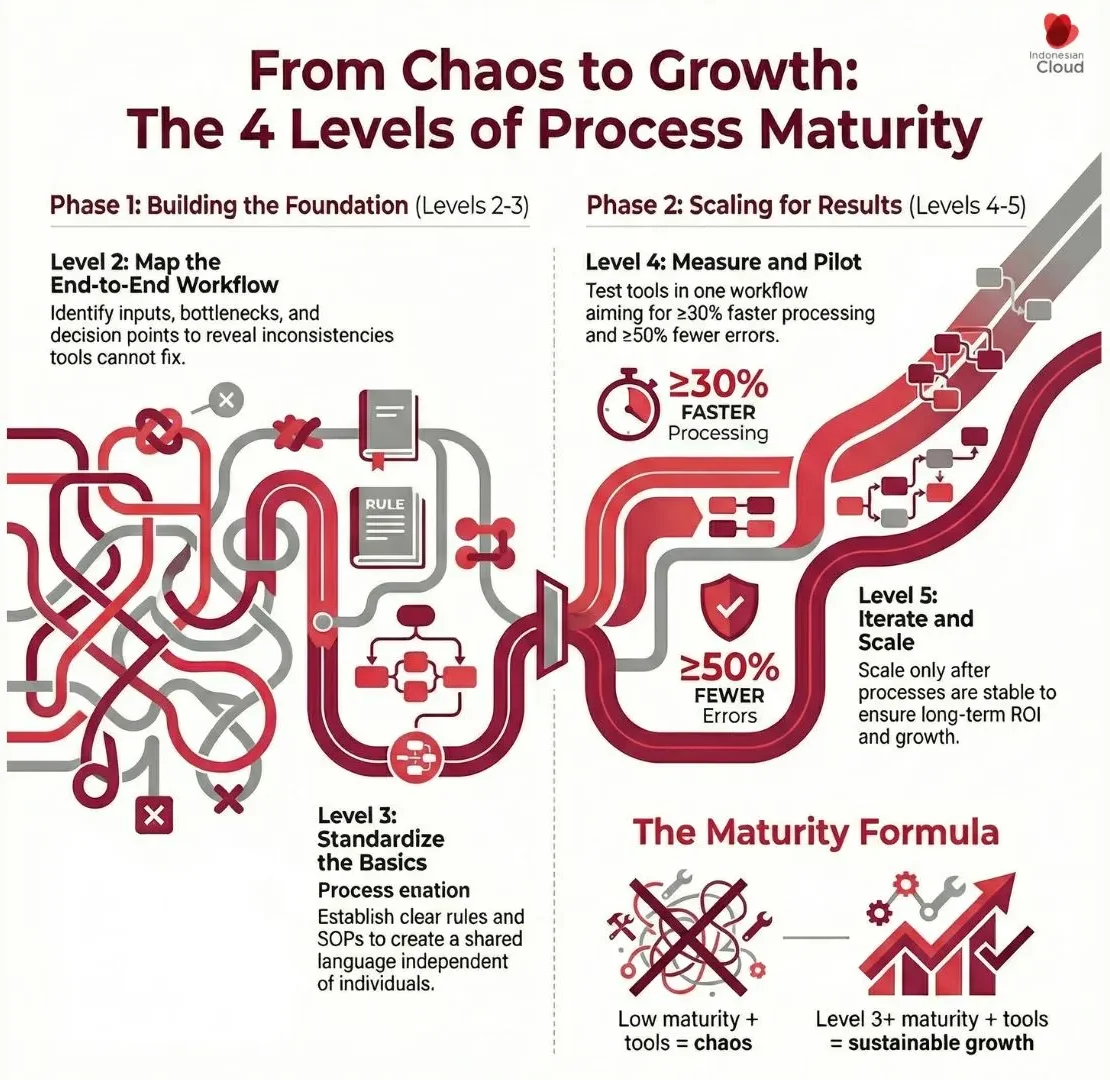
Technology should follow process maturity—not replace it.
Below is a practical four-step approach.
Step 1: Map the Current Process (Managed)
First, map the end-to-end workflow.
Include inputs, bottlenecks, and decision points.
This step often reveals hidden assumptions and dependencies.
Most tools cannot detect these issues automatically.
Step 2: Standardize the Basics (Standardized)
Next, define simple standards.
- Clear definitions
- One-page SOPs
- Clean data rules
The goal is not bureaucracy.
It is shared understanding across teams.
At this stage, processes become scalable.
Step 3: Measure and Pilot Tools (Measurable)
Only now should tools enter the picture.
Test automation in a single workflow.
Set clear KPIs, such as:
- 30% faster cycle time
- 50% lower error rates
- Reduced manual workload
If targets fail, fix the process—not the tool.
Step 4: Iterate and Scale (Optimizing)
Scale only after results stay stable.
At this level, tools reinforce strong processes.
ROI becomes sustainable and predictable.
Process maturity turns technology into a growth engine.
Conclusion
Tools are not the enemy.
But expectations often are.
Broken business processes cannot be fixed by technology alone.
They require clear thinking, discipline, and structure.
Build strong processes first.
Then let tools accelerate the right direction.
At Indonesian Cloud, we believe automation and cloud solutions work best on mature foundations.
That is why we help organizations align process, data, and governance before scaling technology.
Because speed only matters when you are moving the right way.