
Cloud migration mistakes often happen when a company treats cloud as a simple “move.” At first, the plan looks easy. You migrate servers, switch traffic, and move on. However, real migrations are rarely that smooth. Most problems come from planning, people, and execution not from the cloud itself.
Cloud migration mistakes start when cloud is treated like a new data center
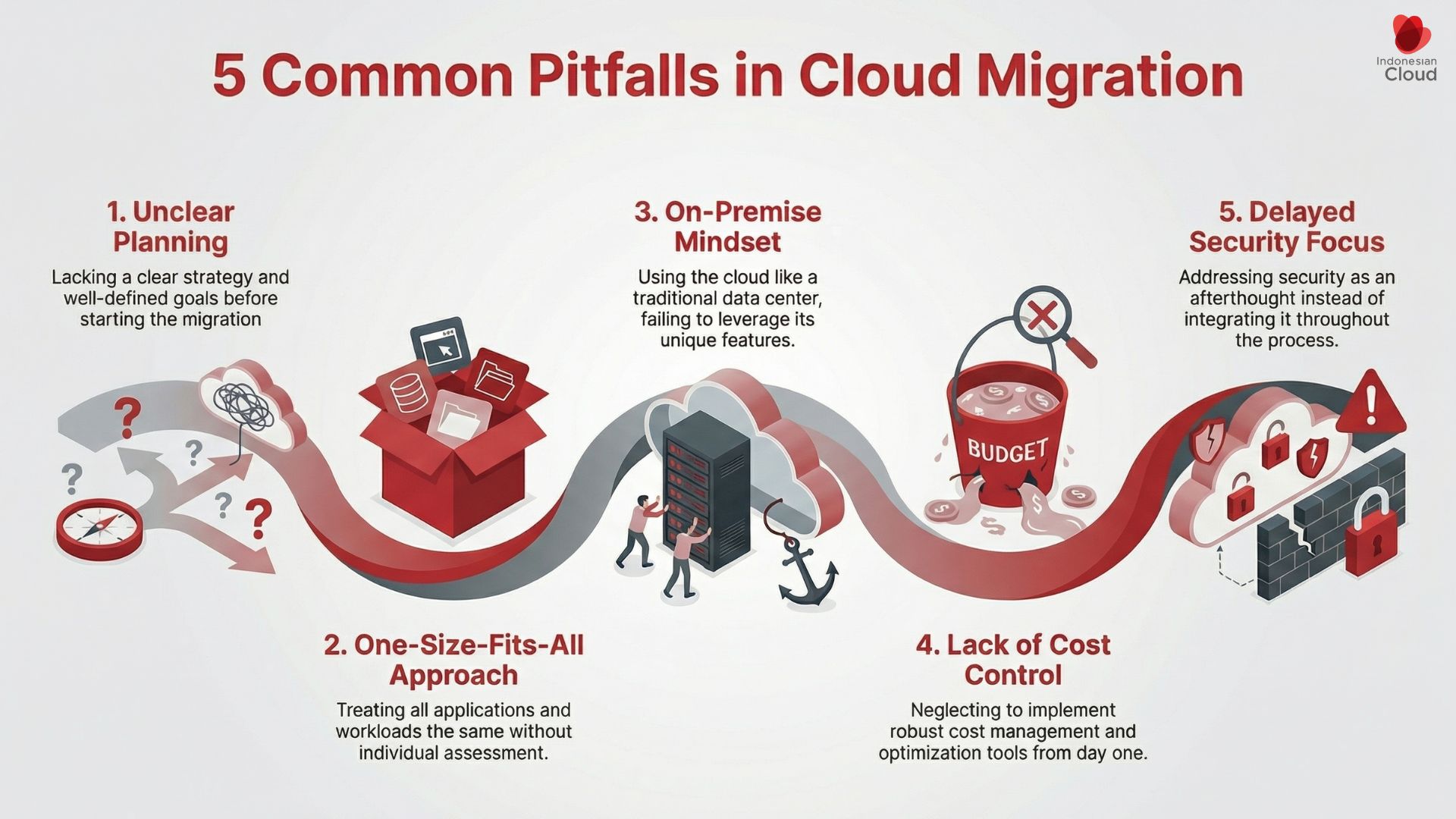
One common misconception is this: cloud migration is only “moving servers elsewhere.” That mindset leads to lift-and-shift decisions without changing architecture or operating habits. As a result, you may pay more, but you do not gain speed, scale, or resilience.
So, before you migrate, align on one thing: cloud is a new way to run IT, not just a new place to host it.
1) Cloud migration mistakes from unclear goals and weak planning
Many teams start with broad targets like “move fast” or “reduce infrastructure cost.” That sounds reasonable. But without clear scope and priorities, the project drifts. Then rework piles up mid-migration.
Cloud migration mistakes fix: map applications and dependencies first
Start with an application map:
- How does each app support the business?
- Which systems does it rely on?
- Which data does it use or store?
- What uptime and recovery targets are required (RTO/RPO)?
Then, migrate in waves. Not everything must move first.
2) Cloud migration mistakes from a one-size-fits-all workload approach
Not all workloads should be treated the same. Some apps need refactoring. Others are safer to migrate in stages. In some cases, keeping a system on the current environment for a period is the best choice. When every workload gets the same approach, risk increases fast.
Cloud migration mistakes fix: choose the right path per application
Use a simple classification:
- Low risk / low complexity: migrate early
- High criticality: migrate with extra testing and rollback plans
- Legacy or fragile apps: consider phased migration or modernization
This keeps operations stable while progress continues.
3) Cloud migration mistakes from focusing on tools, not people and process
Cloud is not only a technology shift. It is also a working model shift. If the team is not ready, cloud can feel harder than before. That happens when processes stay the same while the platform changes.
Cloud migration mistakes fix: build a cloud operating model
Do these early:
- define who owns what (apps, infra, security, cost)
- update change management and incident response
- train teams on daily cloud operations
- start small, then scale
Meanwhile, involve stakeholders from day one. That reduces friction later.
4) Cloud migration mistakes from oversimplified cost assumptions
Cost saving is a common reason to migrate. Yet cloud spending can grow quickly without visibility and discipline. Usually, the cloud is not “too expensive.” Instead, usage is unmanaged.
Cloud migration mistakes fix: set basic FinOps controls from the start
Keep it practical:
- tagging standards for cost allocation
- budgets and alerts per project
- right-sizing reviews every month
- shut down unused resources
- choose reserved/commit options where stable
As a result, cost becomes predictable, not surprising.
5) Cloud migration mistakes from adding security too late
Some teams think about security after systems are already live in cloud. That is risky, especially for critical data and workloads. Security should be part of the design, not a final layer.
draft blog migrasi cloud
Cloud migration mistakes fix: design security early (“shift left”)
Focus on a few high-impact controls:
- identity and access management (least privilege)
- encryption for data in transit and at rest
- secure network segmentation
- logging, monitoring, and incident playbooks
- regular vulnerability management
Also, clarify the shared responsibility model with your provider.
The operational impact of cloud migration mistakes
Cloud migration mistakes rarely show up as one big failure on day one. Instead, they appear gradually:
- operations feel more complex
- costs are hard to forecast
- teams struggle to adapt
- cloud benefits feel “not worth it”
Over time, that can slow digital transformation. So, prevention is cheaper than repair.
A realistic checklist to avoid mistakes
A successful migration is usually gradual and realistic. Here is a simple checklist:
- Set clear business goals (speed, resilience, compliance, cost control).
- Inventory apps and dependencies.
- Group workloads by risk and complexity.
- Choose the right strategy per app (phase, refactor, or hybrid).
- Prepare people and process (training + operating model).
- Put cost control in place (FinOps basics).
- Build security into the design from the start.
In short, treat cloud as a journey, not a one-time project.
Conclusion: reduce migration mistakes with the right guidance
Cloud migration mistakes are common. Still, they are avoidable. Most issues come from unclear planning, mismatched workload strategies, weak readiness, poor cost control, and late security.
With a structured and context-aware approach, cloud migration can become a strong foundation for long-term efficiency and growth. In Indonesia, local infrastructure readiness and hands-on guidance also matter. That is why a local cloud partner such as PT Indonesian Cloud can help teams migrate step by step, stay secure, and align outcomes with business needs.