
AI is often seen as models and algorithms. However, real success often depends on cloud infrastructure for AI. Without it, many AI projects stop at the pilot stage. In addition, costs and operational risks can rise fast.
This article explains the role in a practical way. So you can check your readiness before scaling AI.
What Is Cloud Infrastructure for AI?
Cloud infrastructure for AI is a cloud-based setup. It provides three core needs: compute, storage, and networking.
With it, a company can build AI models. It can train them. It can also run them. This adds flexibility.
Traditional infrastructure is less flexible. Cloud resources can adjust to demand. So teams can scale faster. They also avoid long hardware procurement cycles.
What Does It Usually Include?
It often includes:
- elastic compute for training and inference,
- centralized data storage,
- stable networking for data flow,
- access control and data protection,
- backup and recovery mechanisms.
Because of this, the AI workflow from data → model → production becomes smoother.
The Role of Cloud Infrastructure for AI in Enterprise Implementation
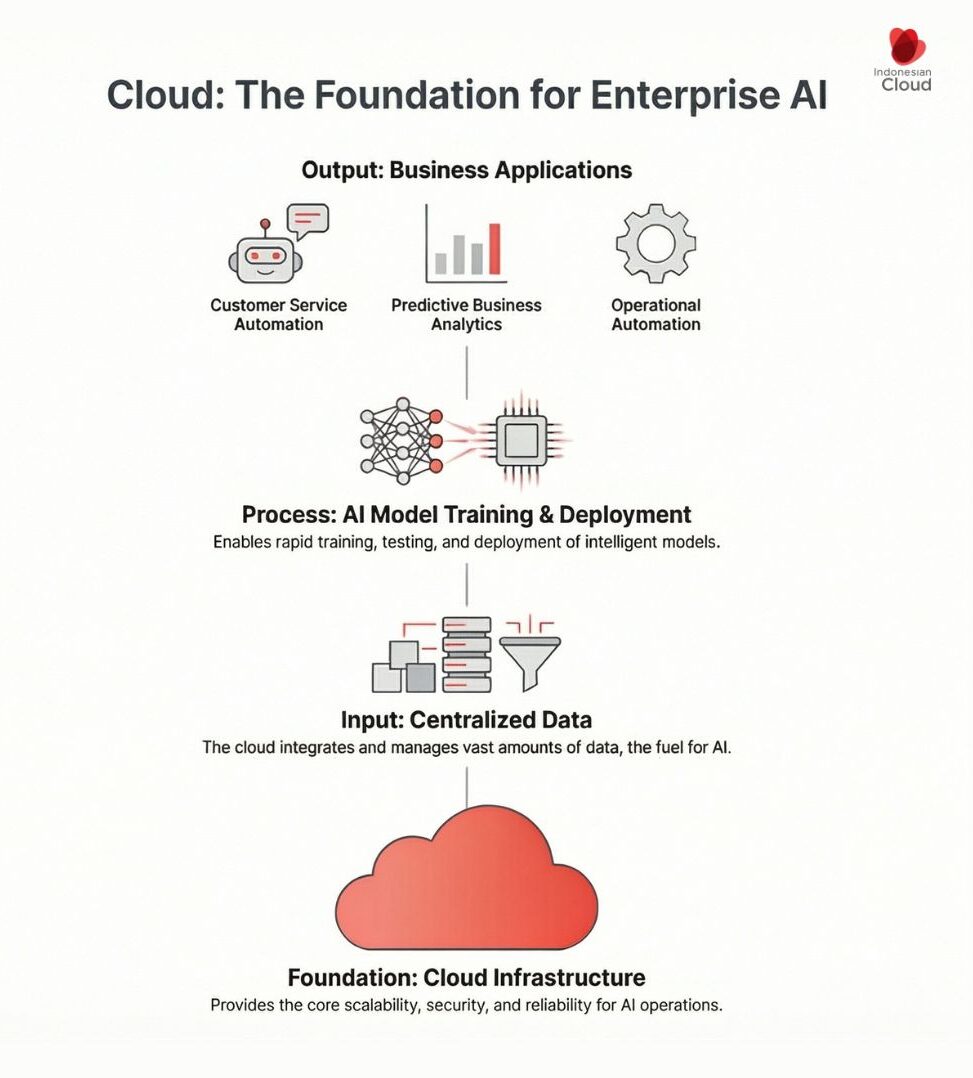
When enterprise AI implementation becomes serious, workloads change quickly. That is why a strong cloud foundation helps control performance, cost, and security at the same time.
1) Scalable Compute and Storage
AI workloads change fast. Training may need high compute for a short time. Inference needs steady uptime.
With cloud infrastructure for AI, capacity can scale up. It can also scale down.
So resources stay efficient. And performance stays stable.
2) Centralized Data Management
3) Security and Data Governance
AI often touches sensitive data. So security becomes critical. Cloud infrastructure for AI typically supports:
- data encryption,
- role-based access control,
- governance policies.
Because of this, the risk of data leaks can be reduced. In addition, internal compliance becomes easier to manage.
4) Reliability and High Availability
Many AI use cases run critical operations. So downtime is expensive. Cloud environments aim for high availability. They also support automated recovery.
As a result, services keep running. They stay stable when demand rises. They also recover faster when issues happen.
The Risks of Implementing AI Without Cloud Infrastructure for AI
Without a solid foundation, AI projects can stall. Compute limits slow testing. So progress slows.
Traditional infrastructure can also be costly. Costs are often hard to predict. Maintenance takes a lot of time. It can drain the team.
Security is another issue. Patching gets harder. As a result, risks go up. Downtime can increase. Data exposure becomes more likely.
Over time, business value may not show up. So the AI investment feels less effective.
Cloud Infrastructure for AI as a Long-Term Foundation
AI is not a one-time project. It keeps evolving. That is why companies need infrastructure that can evolve too.
With cloud infrastructure for AI, companies can:
- expand use cases,
- scale models,
- adopt new AI capabilities,
- maintain security and availability.
So AI can grow step by step, not stop at pilot.
Conclusion
Cloud infrastructure for AI is essential for scalable, secure, and reliable enterprise AI. It helps control costs, speed up development, and protect data.
If you want AI to deliver real impact, start with the foundation. PT. Indonesian Cloud can support your AI transformation with reliable and scalable cloud services.