
AI can improve efficiency. It can also unlock deep data insights. However, AI risks in companies are real. So, adoption without mitigation can create serious problems.
To use AI well, you need a plan. First, understand the risks. Next, reduce them early.
Why AI risks in companies need structured management
AI is not “plug and play.” Instead, it needs risk management.
There are three core reasons:
- Data dependence. Bad or biased data leads to inaccurate output.
- Model complexity. Models are complex. So, errors are harder to detect.
- Higher operational risk. As reliance grows, failures hurt more without mitigation.
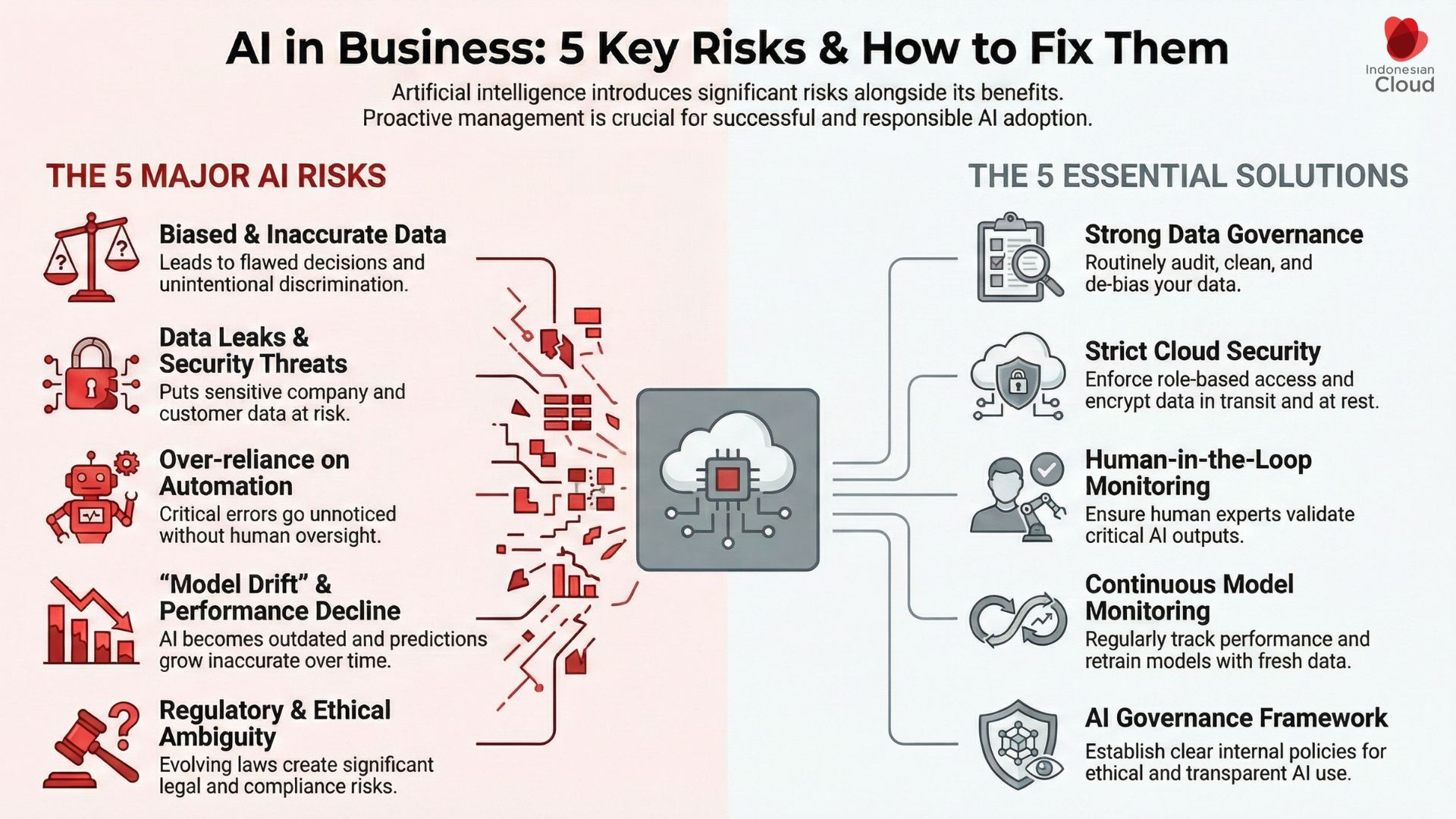
5 AI risks in companies you should watch
Here are five major risks and their business impact.
1) Biased and inaccurate data
This happens when training data is biased or incomplete. It can also happen when data is used out of context. As a result, the model can reinforce historical bias.
Then, decisions can be wrong. Analytics can be flawed. Discrimination risk can rise.
2) Data leaks and security threats
AI systems often handle sensitive data. Therefore, exposure risk increases in weak environments.
This can lead to compliance issues, reputation damage, and direct financial loss.
3) Over-reliance on automation
When teams trust AI too much, human oversight drops. So, system errors become blind spots.
Then, operational mistakes may surface too late.
4) Model drift and performance decline
Over time, models lose relevance. Markets change. Behavior shifts. As a result, accuracy drops.
5) Regulatory and ethical ambiguity
AI and privacy rules evolve fast. So, staying compliant becomes harder.
This may trigger fines, lawsuits, or operational limits.
What happens if you ignore AI risks in companies
These risks compound. In fact, the total damage can be much worse when ignored.
You may lose customer trust. You may face financial loss. Operations can be disrupted. Fixing issues later can cost far more.
How to reduce AI risks in companies
To maximize AI value, use proactive mitigation.
1) Data governance and quality control
First, audit datasets regularly. Next, clean the data. Then, apply bias-reduction techniques.
2) Cloud security and strict access control
Also, use role-based access control. Encrypt data at rest and in transit. Finally, run models in secure or private cloud environments.
3) Human-in-the-loop monitoring
In addition, keep experts in the loop. Let them validate critical AI outputs.
4) Monitoring, retraining, and observability
Next, track performance metrics to detect drift early. Then, retrain models using fresh data.
5) AI governance and compliance framework
Finally, set clear internal policies. Keep model behavior transparent. Run regular AI audits for compliance.
Conclusion
AI creates value. However, it needs strong risk management. Therefore, identify and mitigate risks early for safe and responsible adoption.
A strong tech foundation also matters. With reliable cloud, AI can run safer and more efficiently. PT Indonesian Cloud can support this with managed, scalable cloud services.