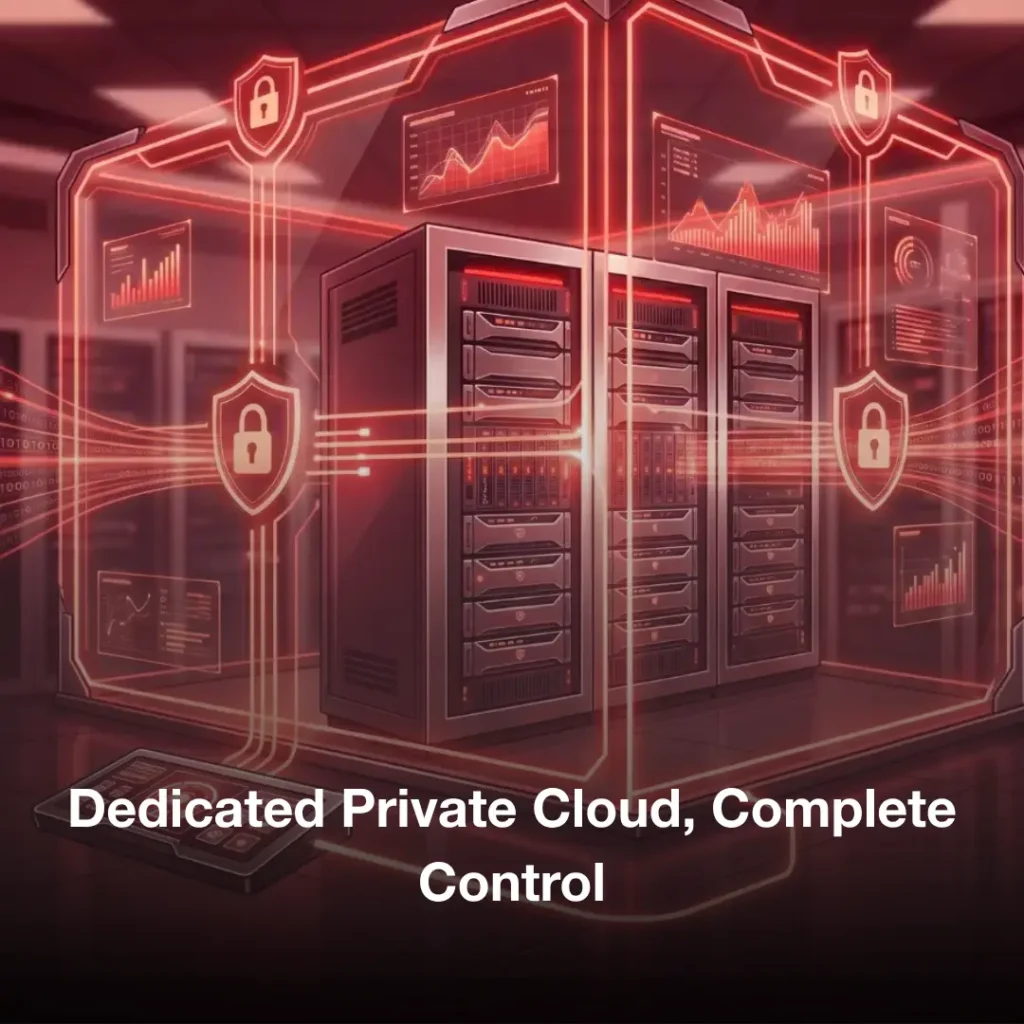
Fully dedicated, secure, high performance servers
Deploy fast and scalable servers for your company
Automatically scale your resource to adapt to changing demands
Physically isolated compute resource pools for your workloads
Boost Performance, Ensure Security.
Manage your Kubernetes service
Best scalable object storage for your company
Persistent block storage
Cloud backup for in-cloud and on-premise resource
Data Protection for cloud servers
Open source database resource to handle massive volumes of concurrent request
RDS for SQL Server is reliable, scalable, inexpensive, and easy to manage.
Open source database that ensure data reliability and integrity
Learning platform to scale up your human resource level
Manage your documents just in one secure and reliable platform
Give you the best mailing experience day to day basic
All for one, one for all, the most comprehensive package you will ever had
Make your Life More Immersive
One Stop Solution for creating your dream website
Digitalize your credit scoring system to the next level
Check your customer credit scoring without wasting your time
Track, manage, your company asset in one click away
Application activation, offers, and automated transactions
Track, analyze, and see what they say about your company trough social media
Track, analyze, and see what they say about your company trough online media
Get the report for your brand trought the online media platform
Get the report for your brand trought your social media platform
Monitor your potential vehicle accidents and disaster with Vehicle Behavior Anomaly
Managing and overseeing Ships with Vessel Behavior Anomaly
Social Media Booster To Boost Your Digital Media Platform
Build Smart Converational Bot for Business at Scale.
Unlock the potential of AI with Keren.AI
Build Customer Interactions in any channels.
Track and monitor any ticket from multiple channel inquiries
Create Live Conversation experience to the next level
Attract and retain Customer for ever lasting relationship
Bring your business into another level by adding new channeling
A Security Operations Center (SOC) is a facility that includes key components to support a company’s network and IT security. Its main purpose is to detect, analyze, and respond to cyber security incidents using a combination of advanced technology and operational processes.
A SOC is essential to strengthen IT security, protect the organization, and maintain business integrity — enabling companies to grow without constant concern about cyber threats. Every company, from startups to global enterprises, is strongly encouraged to have dedicated SOC resources to support long-term operational continuity.
A SOC also commonly includes a Network Operations Center (NOC), which focuses on the monitoring, control, and supervision of network infrastructure. These systems and infrastructure components are continuously monitored to ensure they operate according to service standards and expected performance levels.
A Security Operations Center (SOC) gives you a centralized, complete, and real-time view of your entire infrastructure’s security performance, even when managing multiple locations and thousands of endpoints. Through a SOC, you can detect, identify, and respond to security issues early stopping and resolving them before they escalate and disrupt your business.
Consumers are already skeptical of many companies and worried about their privacy. Implementing a SOC to protect consumer and customer data can help rebuild and strengthen trust in your organization. Most importantly, preventing breaches protects that trust over the long term.
While many organizations assume that building a Security Operations Center (SOC) is expensive, the cost of a cyber breach including data loss, corrupted systems, and customer churn—can be far greater. A SOC team also ensures your company uses the most effective security tools to their full potential, preventing wasted spending on solutions that do not deliver real impact or protection.
A Security Operations Center (SOC) offers key advantages over traditional firewall-only security models by providing deeper visibility into sensitive data at the HTTP layer. A SOC can detect and prevent application-layer attacks that often bypass conventional firewalls.
With a SOC, organizations gain capabilities such as preventing Cross-Site Scripting (XSS) attacks, where attackers inject and execute malicious scripts in other users’ browsers. It also helps stop SQL Injection attacks, which target database-driven applications to access or manipulate critical company data.
Additionally, a SOC can monitor and mitigate Distributed Denial-of-Service (DDoS) attacks, preventing networks from being overwhelmed by malicious traffic and ensuring services stay available for legitimate users.

SIEM stands for Security Information and Event Management. In a Security Operations Center, SIEM delivers two main outputs: reports and alerts. The SIEM reporting feature collects and displays security related incidents, such as threat activity, suspicious behavior, failed login attempts, and other system events. SIEM also provides real-time alerts, which are triggered when the analytics engine detects unusual or potentially harmful activity.

A Security Operations Center introduces a modern approach to security operations, especially for incident response processes. One key component in this approach is SOAR (Security Orchestration, Automation, and Response), which helps improve efficiency, speed, availability, and stability in security operations.
In a SOC environment, SOAR can connect and integrate multiple security tools and applications, enabling security teams to automate response workflows when a breach occurs. As a result, organizations can reduce the time from threat detection to remediation, streamlining the entire process from breach identification through resolution.

A sandbox is an additional protection layer within a Security Operations Center (SOC) used to prevent harmful code or malicious software from attacking and compromising computer systems.
In other words, a sandbox acts as a secure isolated environment that detects and blocks dangerous code before it reaches or impacts the main system. This is why sandboxes are widely used to help prevent malware attacks, including ransomware, trojans, and spyware which are often delivered through unverified software or suspicious files.

Threat Intelligence is a cyber security approach that involves collecting, processing, and analyzing data to understand cybercriminal motives, targets, and behavior. Within a Security Operations Center (SOC), threat intelligence helps IT security teams make faster, data-driven, and well-informed decisions, shifting security actions from reactive responses to proactive protection.

Threat hunting is a continuous process focused on repeated, proactive investigation to identify and understand threat actors that may already exist within your infrastructure. It takes an assume-breach mindset, meaning the security team operates under the assumption that an attacker may be present in the environment, even if prevention measures are already in place.

NDR (Network Detection and Response), a Security Operations Center capability, is a cyber security approach that detects threats by analyzing network traffic behavior. NDR does not act as a primary prevention tool, but it actively stops attacks in progress before they can harm the organization or compromise business systems.

EDR (Endpoint Detection and Response) often referred to as Endpoint Threat Detection and Response (ETDR) is a security system within a Security Operations Center (SOC) that detects and investigates suspicious activity on hosts and endpoint devices. It leverages high-level automation to help IT security teams identify and respond to threats quickly.

Asset Management within a Security Operations Center (SOC) refers to a systematic method for managing company assets, both tangible and intangible, through structured processes to maintain, update, and use them optimally ensuring effectiveness and efficiency.
In a SOC environment, Asset Management functions as a strategic framework to evaluate the purpose, utilization, and overall business value of company assets, enabling organizations to maximize their potential impact and deliver the greatest benefit to the business.
Cyberattacks often happen due to security gaps left open within an organization’s systems. As a central security hub, the Security Operations Center (SOC) is responsible for monitoring all network activities.
Around the clock, the SOC observes databases, websites, applications, and other core business systems. It also tracks external sites flagged as potentially harmful to the company’s cyber environment.
The goal is to quickly detect suspicious activity or security vulnerabilities that could threaten the system. When a security gap is identified early, the SOC can take immediate proactive actions including analyzing the issue, generating security alerts, delivering incident reports, and planning mitigation or preventive strategies to reduce risk and help the organization stay protected.
Companies with dedicated cyber security response teams gain stronger trust from clients and business partners. This is because the top concern for clients and partners is the security of their information. There are countless real cases where cyber attacks caused client data to be exposed, and once that happens, rebuilding trust becomes extremely difficult. Without trust, it becomes much harder to attract new clients and secure long-term partnerships that can support business growth.
Rather than building an in-house cybersecurity team from scratch, a SOC service can save both time and operational costs. A SOC team is typically staffed by trained specialists, eliminating the need for extensive internal training. This means companies can experience effective security performance much faster, without long onboarding delays. As a result, budgets that would normally be spent on cybersecurity training can be redirected to other strategic business needs.
Daripada membangun tim cyber security sendiri, layanan SOC bisa lebih menghemat waktu dan biaya. Tim SOC biasanya terdiri dari para ahli, tidak memerlukan training terlalu banyak. Dan ini artinya perusahaan bisa langsung merasakan keefektivitasan kinerjanya tanpa harus menunggu lama. Anggaran yang seharusnya untuk memberikan training juga dapat dialokasikan pada hal lain.