


Business hosting infrastructure plays a critical role in modern organizations. Today, a website is not just an information channel. Instead, it supports customer data management, transactions, and integration with internal systems.
At first, everything may seem stable. However, digital risk rarely appears overnight. It grows gradually as traffic, data volume, and system complexity increase. As a result, an infrastructure that once felt sufficient can slowly turn into an operational risk.
This article helps you evaluate your business hosting infrastructure from a readiness and risk perspective. In other words, it guides you to assess whether your current setup still supports your growth—or quietly exposes your business to hidden vulnerabilities.
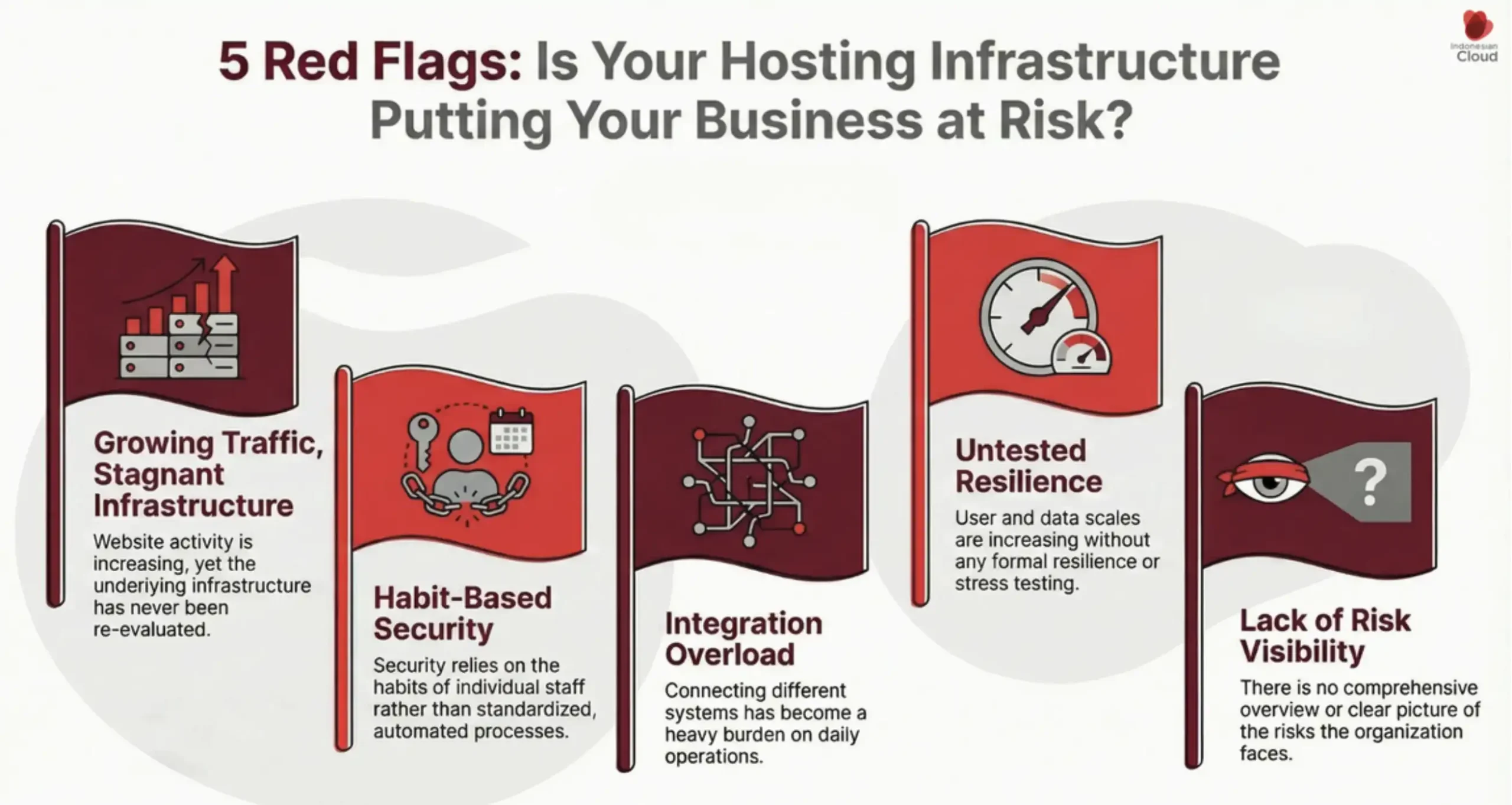
1. Website Activity Grows, but Infrastructure Is Never Reviewed
Over time, most websites expand in function. Initially, they may serve as a company profile. Later, they become lead generation tools, customer portals, or internal access platforms.
However, many organizations keep the same hosting setup they used from day one.
As activity increases, early warning signs appear:
-
Performance becomes inconsistent during peak hours.
-
Random disruptions occur without a clear pattern.
-
The system depends on environments outside your full control.
At first, these issues may seem normal. Yet, when you never review your business hosting infrastructure, small inefficiencies can evolve into operational risk. Therefore, regular evaluation becomes essential—not optional.
2. Security Relies on Habit Instead of Process
Many teams assume their systems are secure simply because no major incident has occurred. Updates happen when convenient. Access permissions are granted as needed. Meanwhile, structured security reviews rarely take place.
This approach may feel practical. Nevertheless, as systems grow more complex, informal habits no longer provide reliable protection.
For this reason, some organizations conduct periodic security assessments with independent experts such as Widya Security. An external review provides objective insight. More importantly, it replaces assumptions with measurable findings.
Strong business hosting infrastructure depends on clear processes. Without them, risk increases quietly in the background.
3. System Integration Becomes an Operational Burden
Modern websites rarely operate alone. Typically, they connect to CRM platforms, ERP systems, payment gateways, and third-party services.
As integrations expand, infrastructure limitations often surface.
Common impacts include:
-
Slower or unstable processes
-
Failed transactions without clear explanations
-
Unsynchronized data across systems
At this stage, risk shifts. It no longer sits solely with the hosting provider. Instead, system owners share responsibility for stability and integration performance.
Therefore, scalable and well-architected business hosting infrastructure becomes critical. Without it, integration growth can weaken operational efficiency.
4. Data and User Growth Increase, but Resilience Is Never Tested
Businesses naturally accumulate more users and more data. However, many organizations do not test system resilience as they scale.
Backups may run automatically. Still, recovery processes often remain untested. Recovery time objectives exist on paper, but no simulation confirms them.
When disruption occurs, reality becomes clear:
-
Recovery takes longer than expected.
-
The impact spreads to other processes.
-
Teams respond reactively instead of proactively.
At this point, infrastructure is no longer just about speed. Instead, it becomes a matter of operational resilience. Testing, simulation, and scenario planning strengthen business hosting infrastructure before real incidents happen.
5. There Is No Clear View of Overall Risk
Without sufficient visibility, decisions rely on a false sense of security. Yet without comprehensive evaluation, organizations cannot clearly identify:
-
The most vulnerable system components
-
The most impactful risks
-
The correct improvement priorities
Because of this, many companies conduct security assessments before major changes such as migration or infrastructure upgrades. A structured review ensures decisions are based on real conditions—not assumptions.
Self-Assessment Checklist: Is Your Infrastructure Still Relevant?
Use the following questions as an initial reflection:
-
Does your website directly support operations or revenue?
-
Have minor disruptions affected customers or internal teams?
-
Is your system connected to multiple external services?
-
Is security management handled through consistent processes?
-
Are there expansion or digital transformation plans ahead?
If most answers are yes, your business hosting infrastructure likely requires evaluation from a readiness and risk perspective.
Infrastructure Is an Operational Decision
Business hosting infrastructure rarely fails on day one. Instead, risk appears when systems grow but management practices stay the same.
By treating infrastructure as an operational decision—not merely a technical matter—organizations gain better control. Consequently, they reduce uncertainty and strengthen long-term stability.
Providers such as Indonesian Cloud offer flexible infrastructure options, from VPS to dedicated servers, tailored to evolving business needs.
At the same time, security-focused partners like Widya Security help ensure that infrastructure decisions are grounded in comprehensive risk understanding.
Ultimately, stable growth depends on infrastructure readiness. Therefore, proactive evaluation today prevents operational disruption tomorrow.