Enterprise Resource Planning (ERP)
An ERP system is an information system designed for manufacturing, distribution, and service companies, with the role of integrating all aspects of business operations.
The history of ERP began with MRP (Material Requirement Planning), which originated during World War I, and later evolved into MRP II (Manufacturing Resource Planning).
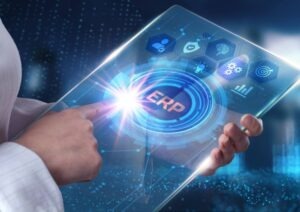
The modules included in an Enterprise Resource Planning system are:
1. Manufacturing
The Manufacturing module covers Material Management, including Production Planning and Control, through to the production of Finished Goods.
2. Supply Chain Management
The Supply Chain Management module covers Logistics and Warehouse Management, from procurement to sales distribution.
3. Finance
Since every process ultimately results in financial reports, the Finance module serves as the endpoint of all modules. This means that all processes related to financial activities automatically generate journal entries within the finance module.
In the IT world, we recognize databases as collections of data stored systematically within computer systems and processed using application programs to generate information. Enterprise Resource Planning systems generally use a single database to make it easier to access real-time, up-to-date information.
In the early 2000s, companies viewed ERP as a large and complex application. Today, developers equip Enterprise Resource Planning systems with features such as Customer Relationship Management (CRM), Project Management, and HR applications. This shift shows how rapidly the IT industry continues to evolve.
Cloud Computing
Cloud computing simplifies how businesses deliver IT services. It provides compute, storage, networking, and other core resources through the internet. As a result, users can deploy, manage, and run software, operating systems, and applications more efficiently. Companies can choose between public and private cloud models based on their needs. It can be either public or private.
The differences between public and private cloud are as follows:
-
Public cloud can be accessed anytime and anywhere, as long as there is an internet connection.
-
Private cloud, on the other hand, is generally owned by a specific group, and access is restricted.
In Indonesia, many people still question the security of public cloud services. They often worry because they do not store data physically on-site and users can access it remotely.
However, the security of public cloud services has been proven. One of the simplest examples of cloud usage in our daily lives is free cloud services such as Gmail, Yahoo, social media platforms (Facebook, Twitter, LinkedIn, etc.), Dropbox, and others. Data stored in these free cloud services does not simply disappear.
For those who do not fully trust public cloud services but still wish to use cloud technology, private cloud can be a suitable alternative.
ERP dan Cloud Computing
Enterprise Resource Planning applications that use cloud technology generally have user-friendly interfaces because they operate through web browsers. By combining cloud technology with Enterprise Resource Planning, data entry becomes much easier for users. In other words, data can be entered from anywhere as long as there is an internet connection, with implementation timelines that are relatively faster compared to on-premise Enterprise Resource Planning solutions.
By Mikael Rommy Kristianto – Project Manager, IndonesianCloud
This concludes our explanation. If you would like to read other articles about technology or obtain more information about IndonesianCloud products, you can visit our website at Indonesiancloud.com, as well as our VPS website at cloudhostingaja.com. See you in our next article.