
A customer sends a complaint by WhatsApp on Friday afternoon. On Monday the same person calls the contact center, having heard nothing. On Wednesday they email a scanned letter. Three teams now hold three fragments of one grievance, and nobody can say when the clock started.
For most Indonesian enterprises that is an operational irritation. For a financial services provider it is a compliance exposure. The deadline for resolving that complaint began running the moment the first message arrived, whether or not any system recorded it.
Consumer complaint volume in Indonesia makes this concrete. Between 1 January and 13 July 2026, the Financial Services Authority (OJK) logged 57,366 complaints through its Consumer Protection Portal Application (APPK). That figure sits within 383,124 total service requests. Financial technology accounted for 25,443 of the complaints, banking 18,578, and financing companies 11,418.
Complaints that reach the regulator are, by definition, the ones a provider’s own channels failed to resolve first. That makes omnichannel customer service a compliance concern as much as a service-quality one.
The complaint clock is shorter than most teams assume
POJK 22/2023 on Consumer and Public Protection in the Financial Services Sector took effect on 22 December 2023. It replaced POJK 6/POJK.07/2022 outright and superseded a substantial part of the earlier complaint-handling rules in POJK 18/POJK.07/2018.
OJK sets out the operative timeline in its own FAQ for the regulation. A financial services provider (PUJK) must follow up and resolve a written complaint within a maximum of 10 working days from receipt of complete documents. One extension of up to 10 further working days is available where circumstances require it. The consumer must be notified in writing before the original period expires. Complaint services cannot be charged to the consumer at all.
Two working weeks is not a generous window once intake, verification, internal routing, and a written response are all counted. It becomes considerably tighter when the intake date itself is uncertain.
The regulation also imposes obligations that are structural rather than procedural. PUJK must receive, record, and document every complaint a consumer submits. They must also maintain a function or unit responsible for receiving, handling, and resolving complaints, and publish information about where that unit can be reached. These are recordkeeping and organizational duties. A well-meaning team working from personal WhatsApp accounts and a shared spreadsheet cannot discharge them.
Fragmentation is where the audit trail breaks
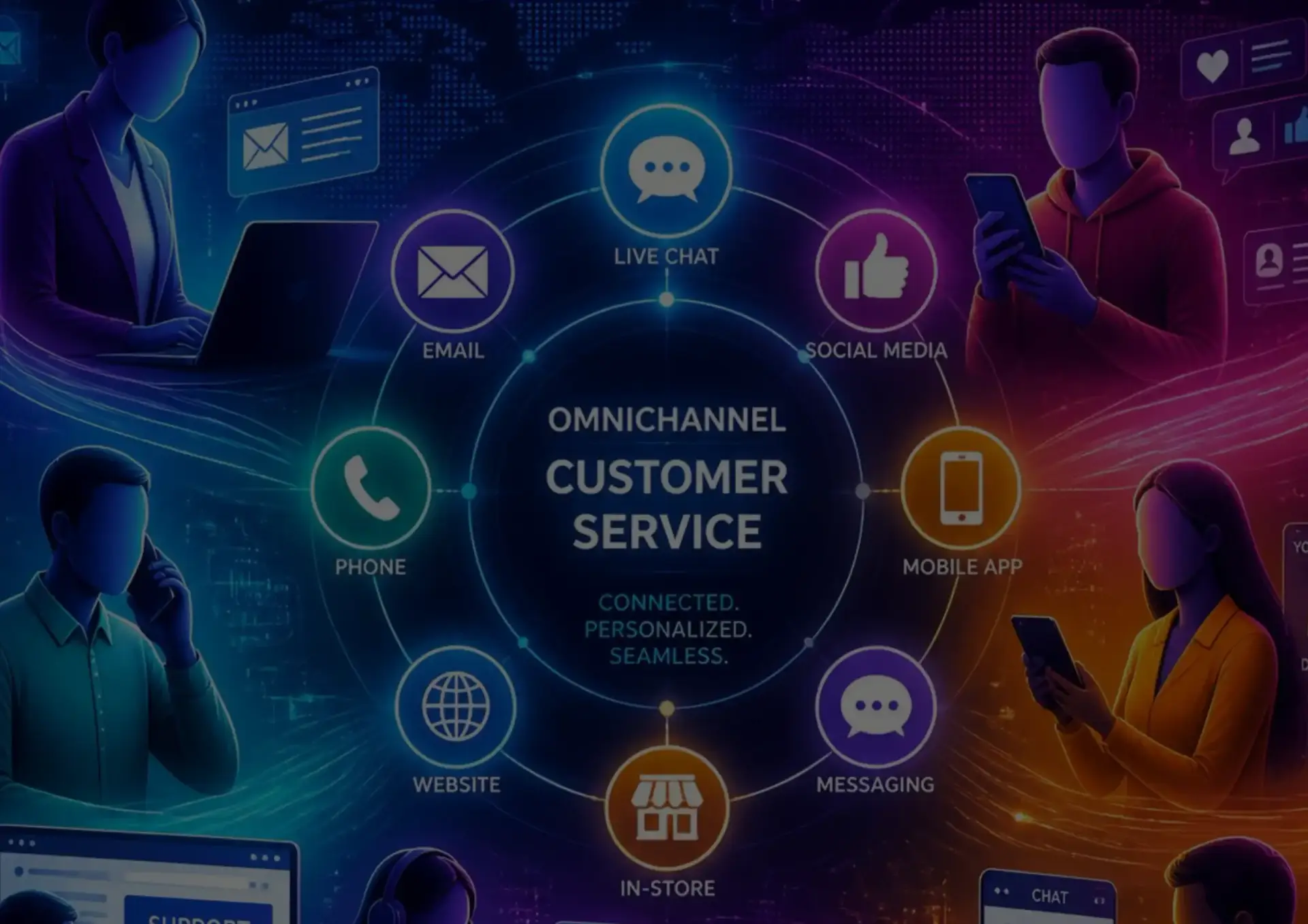
Most Indonesian enterprises did not choose a fragmented service estate. It accumulated. A call center came first, then email, then a WhatsApp Business number added during the pandemic. Instagram and TikTok direct messages followed, usually handled by the marketing team. Somewhere along the way a chatbot was bolted onto the website.
Each channel works. The problems appear between them.
Duplicate cases, divergent answers
The same complaint arriving through three channels becomes three tickets. Two agents may issue different resolutions to the same customer, and both may be logged as resolved. Neither the customer nor the regulator sees three tickets; they see one grievance answered inconsistently.
Uncertain start dates
Suppose a WhatsApp conversation lives only in the messaging app until an agent transcribes it into the ticketing system. The recorded intake timestamp is then the transcription, not the receipt. Every SLA calculation downstream inherits that error. It always errs in the direction that flatters the provider.
Evidence that cannot be produced on request
When a supervisory query or a dispute arrives months later, the provider needs the complete interaction history: what the customer said, what was promised, when, and by whom. That history is often spread across a telephony recording archive, an agent’s chat client, and an email server with a 90-day retention policy. Reconstructing it becomes a project rather than a query.
What a unified omnichannel customer service layer changes
An omnichannel customer service and ticketing platform works as a system of record for customer interactions, much as a general ledger does for transactions. The channels remain many; the case file becomes one.
One case record across every channel
Indonesian Cloud’s Omni Channel & Ticketing platform consolidates interactions from voice, email, web chat, WhatsApp, and social channels into a single customer interaction record. A complaint raised on one channel and continued on another stays attached to the same ticket, with one intake timestamp, one owner, and one resolution.
That single timestamp is the compliance artifact that matters most. It establishes when the clock started, in a form that survives staff turnover and can be produced without reconstruction.
Chatbot and live chat as triage
An AI Powered Chatbot handles the volume that does not need a human: balance queries, document requirements, application status, branch hours. Deflecting routine traffic is valuable in itself, but the compliance value lies elsewhere. The bot can also recognize language that indicates a complaint rather than a question. At that point it creates a ticket, timestamps it, and escalates to an agent through Live Chat with the conversation history intact.
This is a design decision worth being explicit about. Automated conversation should be positioned as an intake and triage mechanism, with a clear and quick path to a human for anything carrying a regulatory obligation. A chatbot that traps a complainant in a loop converts a resolvable complaint into an escalation to the regulator.
SLA timers that reflect the actual deadline
Configuring ticket SLAs against the regulatory window, rather than an internal service target, turns a compliance obligation into an operational dashboard. Two thresholds are worth instrumenting. The first alerts while the initial 10 working days can still be met. The second fires when a written extension notice must go out to preserve the additional period. Missing that notice forfeits the extension, which is an avoidable failure mode.
For outbound service communication, the Campaign module handles multi-channel notification of the kind an extension notice requires. It also keeps a delivery record of each notification sent.
Where the conversation data lives
Complaint records are personal data, and often financial personal data. A customer service transcript can contain account identifiers, transaction details, family circumstances, and health or employment information volunteered in the course of explaining a hardship.
That places the platform squarely within Law No. 27 of 2022 on Personal Data Protection (UU PDP), and, for electronic system operators serving the public, within the placement requirements of PP 71/2019. Consider a service platform that processes conversation logs, recordings, and ticket histories offshore. It introduces a jurisdictional question into the very system meant to produce evidence for an Indonesian regulator.
Indonesian Cloud operates its platforms in Tier III and Tier IV certified facilities inside Indonesia, under Indonesian jurisdiction. Certifications include BSI ISO standards and PCI DSS, and support is staffed locally around the clock. For an omnichannel customer service estate specifically, three adjacencies are worth planning at the same time as the platform itself:
- Object Storage for call recordings and transcript archives, which grow faster than most teams project and are the first thing a retention policy quietly deletes.
- IAM and PAM to control which agents and supervisors can read complaint histories holding sensitive personal data, and to log privileged access to them.
- Data Loss Prevention to prevent exports of customer interaction data through unauthorized channels, a well-documented risk in high-turnover contact center environments.
Sequencing an omnichannel customer service deployment
Across more than 150 enterprise clients in banking, logistics, manufacturing, and retail, the pattern that works is narrow and staged rather than comprehensive.
Start with intake consolidation. Route every existing channel into one ticketing system before changing anything about how agents work. This alone fixes the timestamp problem and produces the first reliable picture of actual complaint volume, which is usually higher than the reported figure.
Instrument the clock next. Configure SLA thresholds against the regulatory deadline and review breach reports weekly. Expect the first month of data to be uncomfortable; that discomfort is the measurement working.
Automate last. Deploy the chatbot against the query categories the consolidated data shows to be highest-volume and lowest-complexity. Automating before measuring means automating the wrong things confidently.
Then extend to proactive service. Once intake is reliable, the same platform supports outbound notification, satisfaction follow-up, and campaign communication, with a full record of what was sent to whom.
Frequently asked questions
How long does a financial services provider have to resolve a consumer complaint in Indonesia? Under the framework OJK describes for POJK 22/2023, a written complaint must be followed up and resolved within a maximum of 10 working days from receipt of complete documents. It can be extended once, by up to 10 further working days, if the consumer receives written notice before the initial period ends.
Does a WhatsApp complaint count as a formal complaint? The obligation to receive, record, and document complaints is not limited by channel. If a provider publicly offers a messaging channel as a service channel, a complaint arriving there is a complaint. Treating it as informal is not a defense.
Can a chatbot handle regulated complaint intake? It can perform intake, classification, and timestamping, which are the parts most prone to human error. What it should not do is act as the final response on a matter carrying a regulatory deadline. Design for prompt escalation to a named human owner.
Where should customer interaction records be stored? Providers subject to UU PDP and the electronic system placement rules in PP 71/2019 should process and store these records within Indonesian jurisdiction. Doing so removes a category of legal uncertainty at exactly the point where records are most likely to be examined.
How long should call recordings and transcripts be retained? Sector-specific obligations and the provider’s own dispute exposure should set retention, not the platform’s default configuration. Confirm the applicable period with your compliance function first, then size storage accordingly.
Talk to an Indonesian Cloud specialist
If your complaint handling spans several disconnected channels, one diagnostic is quick and revealing. Pick a complaint resolved last quarter and try to reconstruct its full history, with timestamps, from your existing systems. How long that takes tells you what you need.
Our team works with enterprises across financial services, logistics, and retail to consolidate customer service channels onto locally hosted, locally supported infrastructure.