
Business Hosting Infrastructure Risk often grows silently. At first, everything works well. The website feels stable. Transactions run without issues. Customers rarely complain. However, traffic increases over time. Systems also become more complex. Small weaknesses begin to appear. Gradually, those weaknesses turn into operational risks. Today, a website is more than an information page. It handles customer data, processes payments, connects with other systems, supports internal workflows. Because of this, companies can no longer ignore infrastructure evaluation. It is not only a technical matter. It is a business decision. This article outlines five clear signs that your hosting infrastructure may already be creating risk.
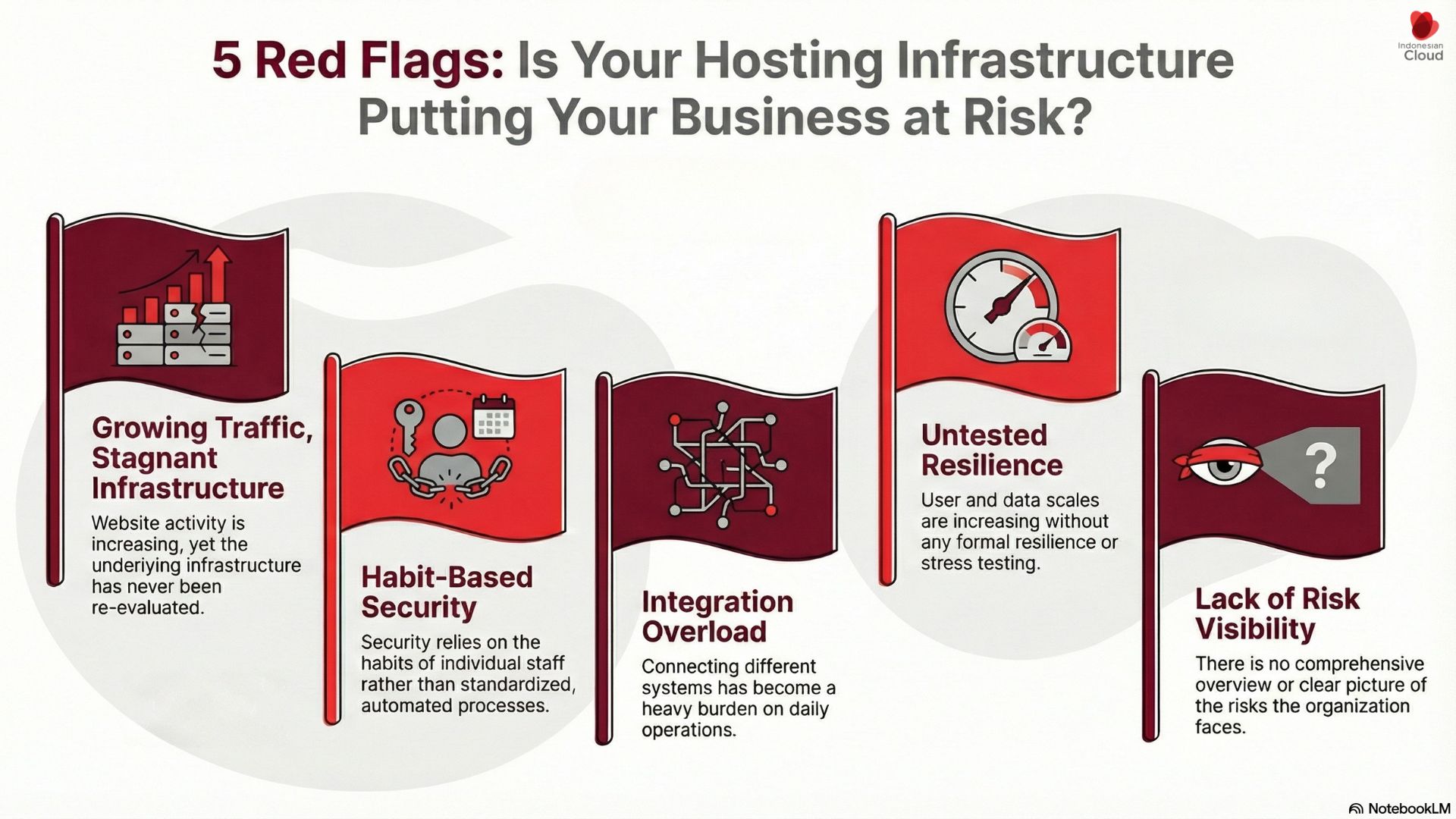
1. Website Activity Grows, but Infrastructure Is Never Reviewed
As your business expands, your website usually gains more functions. For example, it may handle customer portals, transactions, APIs, or internal dashboards.
Yet many companies still use the same infrastructure they deployed years ago.
As a result, you may notice:
- Slow performance during peak hours
- Random downtime
- Limited control over the hosting environment
At first, these issues seem normal. However, without periodic evaluation, Business Hosting Infrastructure Risk increases significantly.
Regular infrastructure review ensures that your system scales with business growth.
2. Security Depends on Habit, Not Process
Many teams feel secure because “nothing bad has happened.”
However, security that depends on habit is fragile.
For instance:
- Updates are done only when necessary
- Access rights are rarely reviewed
- No structured security audit is conducted
Over time, this approach creates hidden vulnerabilities.
Therefore, mature organizations conduct periodic security assessments. Independent firms such as Widya Security provide objective evaluations based on measurable standards.
This approach improves trustworthiness and reduces assumptions.
3. System Integration Becomes an Operational Burden
Modern websites rarely stand alone. They connect with CRM systems, ERP platforms, payment gateways, and third-party services.
As integrations grow, infrastructure limitations become more visible.
Consequently, you may experience:
- Slower system response
- Failed transactions
- Data synchronization issues
At this stage, Business Hosting Infrastructure Risk affects not only IT performance but also business continuity.
Therefore, infrastructure must support integration stability, not restrict it.
4. Data and User Growth Without Resilience Testing
Business growth means more users and more data.
However, many organizations never test system resilience.
Backups exist. Yet recovery simulations are rarely performed.
When disruption occurs:
- Recovery takes longer than expected
- Downtime impacts multiple services
- Teams respond reactively
This situation reveals a critical gap in operational readiness.
Testing disaster recovery procedures strengthens reliability. Moreover, it builds confidence in long-term scalability.
5. No Clear Visibility of Overall Risk
Without comprehensive visibility, decisions rely on assumptions.
You may not clearly know:
- Which system component creates the highest vulnerability?
- Among all identified threats, which one creates the greatest business impact?
- From a strategic perspective, which improvement should leaders prioritize first?
Because of this, many companies conduct infrastructure and security assessments before major upgrades or cloud migration.
Data-driven evaluation reduces uncertainty. It also improves leadership decision-making.
Self-Assessment Checklist: Is Your Infrastructure Still Relevant?
Ask yourself:
- Does your website directly support revenue or operations?
- Have small disruptions ever affected customers?
- Is your system connected to multiple external services?
- Is security managed through consistent processes?
- Are you planning expansion or digital growth?
If most answers are yes, then your Business Hosting Infrastructure Risk deserves structured evaluation.
Infrastructure Is a Strategic Business Decision
Hosting infrastructure rarely fails on day one. Instead, risk increases when business complexity grows but leaders keep the same infrastructure strategy. Therefore, companies must treat infrastructure as an operational investment, not just a technical expense. Reliable providers such as Indonesian Cloud offer scalable solutions, from VPS to dedicated environments, designed for evolving business needs. At the same time, independent security validation from firms like Widya Security strengthens governance and compliance readiness. Ultimately, stable infrastructure enables sustainable business growth. And sustainable growth requires proactive risk management.